A fascinating journey from the first Polynesian seafarers to the modern renaissance.
🌊 The most important thing first: Kava is not just a drink - it is 3000 years of living culture, spirituality, and tradition. Those who drink Kava become part of one of humanity's richest cultural histories.
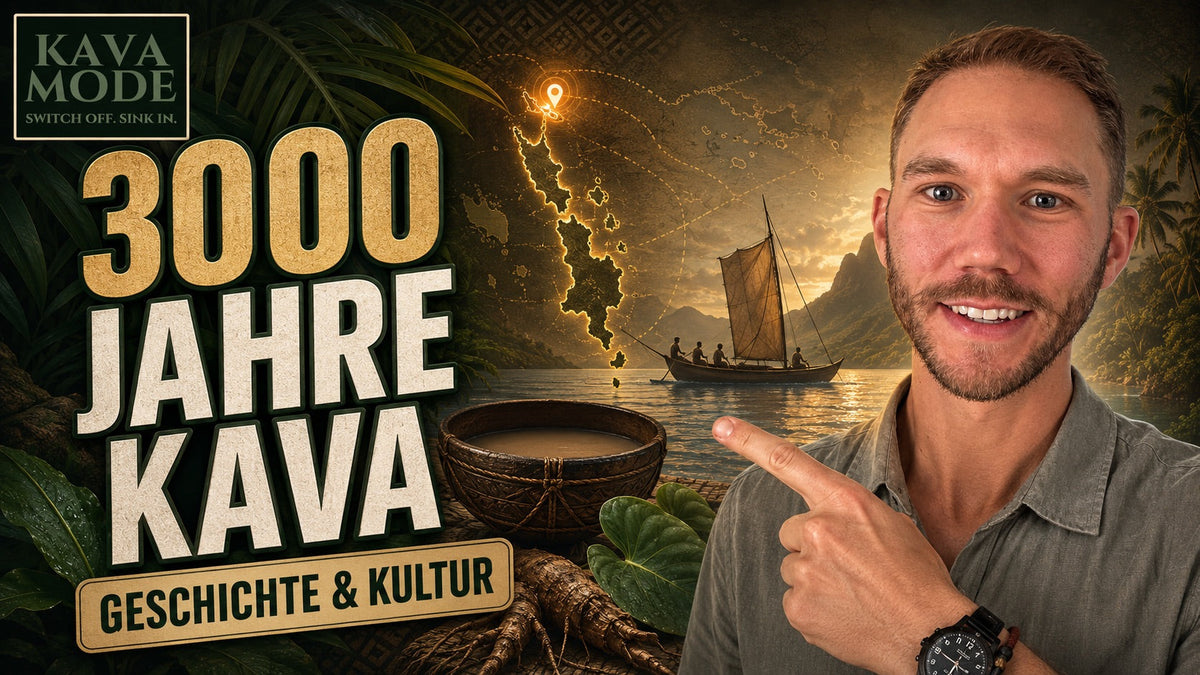
Welcome to a fascinating journey through 3000 years of Kava history and culture. From the first Polynesian seafarers to the modern wellness movement - discover why Kava is far more than just a drink.
As a naturopathy specialist with over 10 years of experience and 1.5 years of intensive Kava work, I will take you on a journey that shows: Everyone who drinks Kava becomes part of this history. And those who know the history can treat Kava with the respect it deserves.
🏛️ Why Kava History is Important
Kava is living culture. Those who understand its history don't just drink a beverage - they participate in 3000 years of wisdom, spirituality, and human connection. This brings with it responsibility and respect.
📋 Table of Contents
- The origins: Vanuatu 1000 BC – Nakamal and Kava in Vanuatu
- Polynesian spread across the Pacific – Fiji · Tonga
- Spiritual and Political Significance
- European Explorers and Captain Cook
- Colonial Era and Missionization
- Modern Rediscovery
- Respect for Tradition Today
- Complete Kava Timeline
- Conclusion: Kava as Living Culture
1. The Origins: Vanuatu 1000 BC
Our story begins approximately 3000 years ago on the islands of Vanuatu. Here, in the heart of the South Pacific, the first people discovered a remarkable plant: Piper methysticum - Kava.
The Legend of the First Kava
🌿 The Origin Legend
The traditional legend tells of a chief who sacrificed his daughter to save his people from a great catastrophe. From her grave grew the first Kava plant - a gift from the gods for peace and harmony.
Symbolism: Even in the origin legend, Kava stands for sacrifice, community, and divine blessing. These themes run through the entire Kava culture.
Scientific Genesis
Scientifically, Kava evolved from wild Piper species through centuries of selection. The people of Vanuatu recognized early on the special properties of certain plants and systematically cultivated the first Noble Kava varieties.
Why Vanuatu? Vanuatu's geological and climatic conditions are perfect for Kava:
- Volcanic soils with high mineral content
- Tropical climate with sufficient rainfall
- Isolated island location for undisturbed development
- Cultural stability over millennia
Kava in Vanuatu: Nakamal, community and local traditions
If you are looking for a Kava ceremony in Vanuatu, you will often come across the term Nakamal. It refers to a traditional communal meeting place. In everyday urban life, the word is also used for Kava bars. A visit there is therefore not automatically a formal ceremony.
The Vanuatu Tourism Office often describes Kava rounds as evening, quiet gatherings. The shared location and the encounter are just as important as the drink. Which rules apply depend on the location and its hosts - a Kava bar in Port Vila is not the same as any traditional gathering place on another island.
As a guest: Let us explain to you where you are allowed to sit, whether conversation or silence is expected and whether photography is welcome. Do not transfer the greeting or clapping protocol known from Fiji to Vanuatu without asking. An invitation is an opportunity to listen, not a claim to a staged ceremony.
Sources: Vanuatu Tourism Office – Culture and How to drink Kava.
2. Polynesian Spread Across the Pacific
Between 1000 BC and 500 AD, something extraordinary happened: The Polynesian seafarers, the greatest navigators in human history, spread Kava throughout the Pacific.
The Great Seafarers
⛵ The Polynesian Expansion
With their outrigger canoes, Polynesian seafarers sailed thousands of kilometers across the open ocean. And in every canoe: Kava cuttings. Because Kava was not just medicine - it was culture, identity, and home.
These seafarers navigated without compass or maps, using only stars, waves, and bird flight. The fact that they brought Kava with them demonstrates its immense cultural value. Space in a canoe was precious - only the most important things came along.
Cultural Development on the Islands
On each island, unique Kava traditions developed, shaping the local culture:
| Island/Region | Name | Special Feature |
|---|---|---|
| Fiji | Yaqona | Sevusevu ceremony, drink of chiefs |
| Tonga | Kava | Formal occasions and social Kava clubs; Language and community |
| Samoa | Ava | Spiritual practices, drink of wisdom |
| Hawaii | Awa | Sacred ceremonies, later almost extinct |
Kava ceremony in Fiji: Yaqona, Sevusevu and respectful participation
A Kava ceremony is not the same sequence everywhere. In Fiji, Kava is also known as Yaqona. At Sevusevu, visitors traditionally bring a Kava gift and ask the host community for acceptance or access. The formal beginning includes an exchange between the speakers of the guests and hosts - not silence until after drinking.
For a normal drinking session, Tourism Fiji describes clapping before and after accepting the bowl. However, you shouldn't make this a rigid protocol for every island and every occasion. The seating arrangement, greeting and procedure are best explained by the host or the local companion. Source: Tourism Fiji – Guide to Drinking Kava in Fiji.
For you as a guest: Ask in advance what is expected and also address personal boundaries. Respect doesn't mean having to drink something out of politeness. Ask permission before taking photos or recordings. A private Kava session at home is no substitute for a specific, traditional ceremony.
Our Kava beginner's guide explains how the plant, the drink and the culture are related.
Kava in Tonga: ceremony, Kava clubs and lived community
In Tonga, Kava plays a role in both formal encounters and everyday social life. The Te Papa Museum describes how special guests and occasions are recognized through the formal Kava presentation. A Kumete, the wooden Kava bowl, is one of the objects of this culture.
There are also informal groups and Kava clubs. This can include conversations, singing and humor. Sitting together is also a place where Tongan language and culture are passed on. “Kava ceremony in Tonga” therefore does not describe every round equally well: a formal occasion and a social evening have different rules and meanings.
As a guest: Ask what the purpose of the group is and how you can get involved. Instructions from Fiji do not replace an explanation from your Tongan hosts. The differences make Kava culture interesting - not a ranking of the supposedly "most complex" ceremonies.
Source: Te Papa – Kava drinking and Tongan culture.
Samoa: Ava and Spiritual Wisdom
In Samoa, Kava became 'Ava' - the drink of wisdom. Here, Kava was particularly used for spiritual practices, decision-making, and communication with ancestors.
Samoan Ava ceremonies are known for their spiritual depth. Participants report increased intuition, clearer dreams, and a feeling of connection with the ancestral world.
3. Spiritual and Political Significance
Kava was never just a drink. It was - and is - a political and spiritual instrument of immense power that shaped entire societies.
Political Power of Kava
👑 Kava as a Political Instrument
In traditional Pacific societies, Kava decided on war and peace. Chiefs met in the Nakamal - the Kava house - to discuss, negotiate, and decide.
The rules were clear:
- He who drinks Kava speaks the truth
- He who shares Kava makes peace
- He who refuses Kava declares war
These rules were not symbolic - they had real political power. Kava ceremonies decided on alliances, trade relations, and territorial conflicts.
Spiritual Dimensions
Spiritually, Kava opened the doors to the spirit world. In many cultures, it was believed that Kava enabled communication with ancestors, enhanced dreams, and brought spiritual clarity.
Important: Kava is not a hallucinogen. It does not alter perception like psychedelic substances. Instead, it acts as a 'consciousness opener' - it calms the ego and allows for deeper spiritual experiences.
Modern Spiritual and Political Relevance
These traditions are still alive today:
- Vanuatu: Prime ministers are inaugurated with Kava ceremonies
- Fiji: Kava is part of the official state culture
- Tonga: The King drinks Kava with his people on important occasions
- Samoa: Parliament sessions often begin with Ava ceremonies
This shows: Kava is not just history. It is living tradition that continues to hold political and spiritual power today.
4. European Explorers and Captain Cook
In 1768, Captain James Cook stepped onto the islands of the South Pacific. What he saw there changed the Western understanding of plants and culture forever.
Captain Cook's First Encounter
📜 Captain Cook's Original Quote
"They chew this root and spit the juice into a bowl. The drink makes them calm and peaceful, but not drunk like our alcohol. It is remarkable how serene and friendly they become after drinking."
- Captain James Cook, Journal 1769
Cook was fascinated by the relaxing effect without loss of control. In his detailed journals, he describes the 'intoxicating root' and the complex ceremonies he observed.
Scientific Documentation
Georg Forster, the naturalist on Cook's second voyage, documented the first scientific observations about Kava. He realized: This was not a primitive drug, but a highly developed medicine.
Forster's important findings:
- Kava acts differently than alcohol - more peaceful and social
- Preparation follows complex, ritualized rules
- Kava has important social and political functions
- The effect is dose-dependent and controllable
First Western Reactions
The reactions of Europeans were mixed:
Scientists and explorers were fascinated. They brought the first Kava samples to Europe and began to research the active ingredients. The foundation for modern Kava research was laid.
Missionaries saw it differently. For them, Kava was a 'pagan drink' that deterred people from the Christian message. This attitude would shape the next 200 years.
Traders and colonial officials quickly recognized the political value of Kava. Those who understood Kava culture could negotiate more successfully and forge alliances.
5. Colonial Era and Missionization - Kava as a Symbol of Resistance
With the colonization of the Pacific, one of the most difficult periods in Kava history began. European powers and Christian missionaries saw Kava as a threat to their authority.
Missionary Opposition
⛪ Missionary Arguments Against Kava
- "Makes lazy": Kava drinkers are less productive
- "Pagan": Kava ceremonies compete with Christian services
- "Immoral": Communal drinking leads to 'sinful' behavior
- "Resistant": Kava culture strengthens local identity against colonial authority
In many regions, Kava ceremonies were banned and replaced by prayer meetings. Missionaries preached against the 'sin of Kava drinking' and threatened spiritual consequences.
Kava as a Symbol of Resistance
But Kava was too deeply rooted in the culture. Instead of disappearing, it became a symbol of resistance. Those who drank Kava preserved their identity against cultural uprooting.
Strategies of cultural resistance:
- Secret ceremonies: Kava was drunk in secret
- Syncretism: Kava was integrated into Christian practices
- Political instrumentalization: Chiefs used Kava for diplomacy
- Cultural persistence: Traditions were consciously preserved
Different Colonial Approaches
| Colonial Power | Approach to Kava | Result |
|---|---|---|
| British Empire | Tolerance, diplomatic use | Kava survives, integrated into state culture |
| French Empire | Skepticism, cultural assimilation | Partial suppression, underground culture |
| German Colonies | Scientific Interest | First pharmacological studies |
| American Missionaries | Strict Rejection | Kava almost eradicated (Hawaii) |
Successful Resistance Strategies
Fiji: The chiefs developed a clever strategy. They integrated kava into the official colonial culture. British governors were received with kava ceremonies. Thus, kava transformed from a forbidden drink to a diplomatic instrument.
Vanuatu: Under French-British dual rule, a strong kava underground culture emerged. The confusion between the colonial powers allowed traditions to survive.
Tonga: As a kingdom never fully colonized, Tonga was best able to preserve its kava culture. The most complex ceremonies were maintained here.
Syncretistic Movements
Interesting are the syncretistic movements - religious currents that combined traditional and Christian elements. Some progressive missionaries recognized the value of kava and integrated kava ceremonies into Christian services.
This led to new forms of ceremonies where prayer and kava rituals coexisted. These traditions still exist in some Pacific churches today.
6. Modern Rediscovery and Renaissance
In the 1980s, the modern rediscovery of kava began. Western scientists researched kavalactones and discovered their enormous therapeutic potential.
Scientific Renaissance
🔬 Scientific Breakthroughs
1980s: First isolation and analysis of kavalactones
1990s: Clinical studies show efficacy against anxiety and stress
2000s: Mechanism of GABA modulation understood
2010s: Renaissance after liver controversy, quality standards established
Studies showed: Kava works against anxiety, stress, and sleep problems - without the side effects of synthetic drugs. The wellness movement was enthusiastic.
Global Spread
Kava bars emerged in the USA, Germany, Australia. Suddenly, city dwellers were drinking the same beverage as Pacific chiefs 3000 years ago.
Important milestones in global spread:
- 1980s: First kava extracts in German pharmacies
- 1990s: Kava bars in Florida and California
- 2000s: European wellness movement discovers kava
- 2010s: Online trade enables global access
- 2020s: Kava as an alcohol alternative in the mainstream
The Liver Controversy (2002-2014)
But there were also problems. The liver controversy of 2002 showed: Not all kava products are the same. Poor quality, incorrect plant parts, and alcohol combinations led to health problems.
This was a turning point. Pacific countries, especially Vanuatu, realized: They had to protect their tradition. Laws were enacted prohibiting and penalizing the export of inferior Tudei kava.
Quality Renaissance
Today we are experiencing a renaissance of quality. High-quality Noble Kava from Vanuatu is conquering the world market - not as an exotic drug, but as a respected medicine.
The modern kava movement combines the best of both worlds: traditional wisdom and modern science. Quality providers like Kava-Mode focus on transparency, education, and respect for tradition.
7. Respect for Tradition Today
What does this mean for us today? When you drink kava, you are not just drinking a beverage. You are participating in 3000 years of culture, wisdom, and tradition. This brings responsibility.
Cultural Responsibility
🙏 Respect for tradition means:
1. Choose quality: Use only high-quality Noble Kava from Vanuatu. The people there have preserved this tradition and deserve our respect.
2. Understand culture: Kava is not just relaxation - it is community, spirituality, and peace. We should honor these dimensions.
3. Honest education: Kava is safe and valuable, but it deserves honest, respectful communication without exaggeration or downplaying.
4. Fair partnerships: Support providers who work directly with Pacific farmers and pay fair prices.
Modern Kava Ethics
At Kava-Mode, I implement these very principles. Honest education is the basis for trust for me - and respect for tradition is the basis for quality.
Practical implementation:
- Direct partnerships with Vanuatu farmers
- Full transparency about origin and quality
- Cultural education instead of mere sales promotion
- Fair prices for traditional producers
Kava as a Bridge Between Cultures
When you drink kava with this awareness, you are not only honoring the past. You become part of a movement that connects tradition and modernity, that bridges cultures, and that shows: respect and quality go hand in hand.
8. Complete Kava Timeline
📅 3000 Years of Kava History at a Glance
1000 BC - Origins in Vanuatu
First cultivation of kava from wild Piper species. Development of the first Noble Kava varieties.
500 BC - 500 AD - Polynesian Expansion
Seafarers bring kava to Fiji, Tonga, Samoa, Hawaii. Development of regional traditions.
500-1600 AD - Cultural Flourishing
Complex ceremonies emerge. Kava becomes a central part of Pacific politics and spirituality.
1768 - Captain Cook's Discovery
First Western documentation of kava. Cook describes the "intoxicating root" in his journals.
1800-1900 - Colonial Era and Missionization
Missionaries fight kava as "pagan". Kava becomes a symbol of resistance against cultural uprooting.
1886 - First scientific analysis
German researchers isolate the first kavalactones and begin pharmacological studies.
1945-1980 - Cultural Renaissance
Pacific countries gain independence. Kava traditions are revived and strengthened.
1980-2000 - Western Rediscovery
Clinical studies show therapeutic potential. Kava bars emerge in the USA and Europe.
2002-2014 - Liver Controversy
Health problems due to poor quality lead to bans. Vanuatu tightens export controls.
2014-Today - Quality Renaissance
High-quality Noble Kava conquers the global market. Focus on respect for tradition and quality.
9. Conclusion: Kava as a Living Culture
3000 years of kava history show us: this plant is something special. It has shaped cultures, ended wars, promoted spirituality, and connected people.
Key Insights
- Kava is Culture: Not just medicine, but a living tradition with immense cultural significance
- Tradition survives: Despite colonization and missionization, kava has preserved its cultural power
- Quality is key: Noble Kava from Vanuatu is the gold standard - for good reason
- Respect is important: Whoever drinks kava bears responsibility for this tradition
- Modernity meets tradition: The best kava future combines traditional wisdom with modern science
From the First Seafarers to Today
From the first Polynesian seafarers to modern wellness enthusiasts - kava connects us all in a shared tradition of peace and harmony.
The most important lesson: Kava is not just medicine. It is culture. And culture deserves respect.
📚 Further Resources
For even more details on kava history and culture, I recommend my book "Kava - Root of Calm: A Comprehensive Guide to Effects, Application, History & Culture". There you will find many more stories, legends, and cultural details.
For high-quality Noble Kava from Vanuatu - with respect for tradition:
Your Role in Kava History
When you drink kava today, you become part of this 3000-year history. You honor the Polynesian seafarers who brought kava across the Pacific. You respect the chiefs who used kava for peace. You acknowledge the people of Vanuatu who have preserved this tradition.
This is more than consumption - it is cultural participation. And with this participation comes the responsibility to treat kava with the respect it deserves.
About the Author
Sebastian Freidank has been involved with naturopathy, biohacking, and indigenous plants for over 10 years. For 1.5 years, he has been working intensively with kava and brings the principles he has practiced at drinkguya.com for almost 9 years: direct collaboration with farmers, transparency, and sustainable practices. As the founder of Kava-Mode, he advocates for quality, cultural respect, and honest communication in the kava world.
🌊 Tradition Meets Modernity
Discover high-quality Noble Kava from Vanuatu - with respect for 3000 years of tradition.
Discover Traditional Noble Kava
Noble Kava from Vanuatu • Cultural Respect • Honest Education