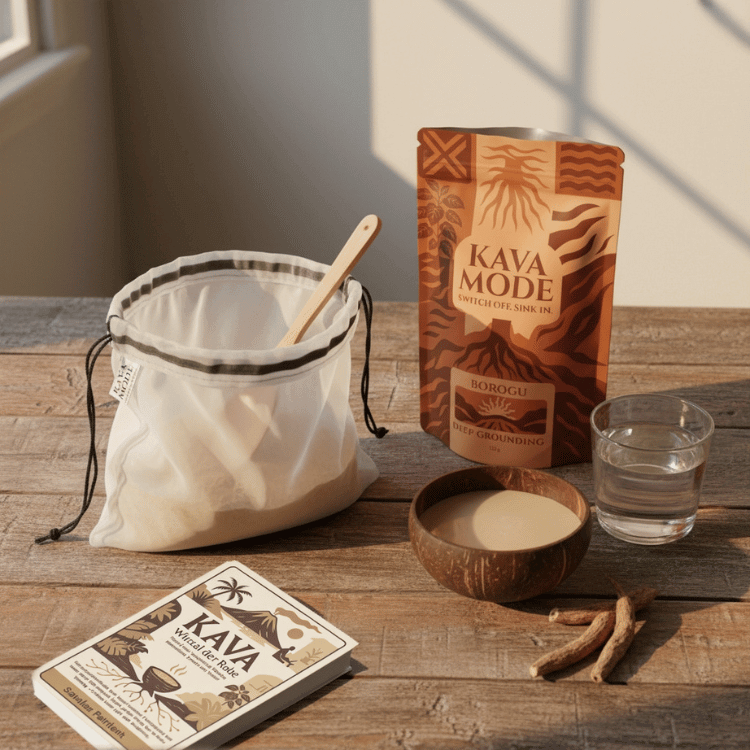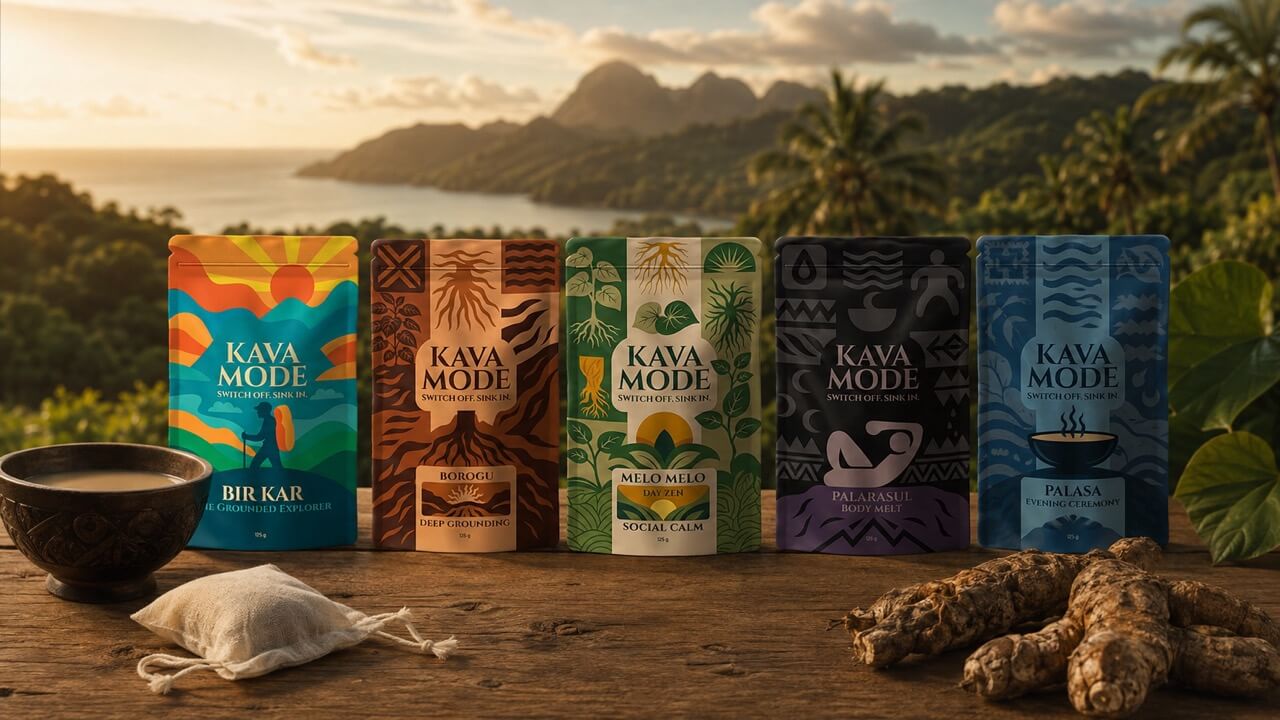
Noble or Tudei? Root powder or extract? Balanced, Heady or Heavy? This guide shows you step-by-step what you really need to look for when buying Kava.
Anyone looking to buy Kava will quickly encounter significant differences in quality. Some offers mention neither the exact variety nor the plant parts used. Others primarily advertise strength, without clearly explaining the origin, processing, or traditional suitability. This is precisely where the decision lies whether you buy a transparent Noble Kava product or just any powder named Kava.
This buying guide will help you to recognize Noble Kava from Vanuatu, categorize varieties meaningfully, and realistically compare product forms. You will also learn what is behind search queries like "buy Kava Kava Germany" or "buy Kava Kava dm" and why a specialized provider usually offers more guidance than a general drugstore or marketplace listing.
The most important things at a glance
- Choose Noble Kava: For traditional use, the variety should be explicitly designated as Noble Kava.
- Check variety and origin: A reputable offer names the cultivar, country of origin, and, if possible, the island or region.
- Underground plant parts: Root and rhizome belong in a traditional Kava product, not leaves or aerial stems.
- Understand product form: Traditional root powder for water preparation is not the same as extract, capsule, or tincture.
- Choose profile appropriately: Balanced, Heady, and Heavy are guidelines, not guaranteed promises of effect.
- Transparency over superlatives: Specific information on variety, processing, and preparation is more important than words like "extra strong."
- Start small: A smaller pack or a sample pack is more sensible for initial variety comparison than a large bulk purchase.
Table of Contents
- Buying Kava: The short answer
- Buying Kava Kava in Germany
- Noble Kava instead of Tudei
- The Quality Checklist
- Powder, Instant, Capsules or Extract?
- Balanced, Heady or Heavy?
- Five Noble Kava varieties in comparison
- Buying Kava Kava at dm?
- Properly comparing price and value
- Consider filter and preparation
- Safety and Legal Status
- Kava Buying FAQ
- Conclusion
- Sources and further links
1. Buying Kava: The short answer
You don't recognize good Kava by particularly dark packaging, a high number on the label, or a spectacular promise of effect. What matters is whether the provider can transparently answer what is in the package and where it comes from.
For a traditional introduction, dried, finely ground Noble Kava root material for preparation with water is the clearest product form. The Codex Alimentarius of FAO and WHO lists a specific regional standard for this: Kava products that are used as a beverage when mixed with water. The standard does not replace a German legal review but shows how traditional Kava goods can be described internationally as a clearly defined food product.
The most important buying rule
Don't just buy "Kava." Buy a named Noble variety from a traceable origin, made from suitable underground plant parts, and with clear instructions for traditional water preparation.
2. Buying Kava Kava in Germany: What matters?
Anyone looking to buy Kava Kava in Germany should first distinguish between three levels: product quality, product presentation, and legal status. A well-known brand or a German shipping location alone does not guarantee good raw material. Conversely, a product from Vanuatu is not automatically high-quality if the variety, plant parts, and processing remain unclear.
A trustworthy German or European shop should make at least the following information easily accessible:
- complete product name and botanical classification as Piper methysticum,
- clear labeling as Noble Kava,
- name of the cultivar, for example, Melo Melo, Bir Kar, or Borogu,
- country of origin and, if possible, more precise origin,
- plant parts used,
- product form and understandable preparation instructions,
- responsible merchant data, ingredients, and fill quantity
A provider who discloses origin and variety gives you a verifiable basis. A provider who merely writes "Kava Kava Powder - extra strong", on the other hand, demands trust without providing the necessary information.
3. Noble Kava instead of Tudei: The decisive quality distinction
Noble Kava refers to traditionally valued cultivars that have been selected for the usual beverage context. Tudei, also known as "Two-Day Kava," stands for varieties with a profile that often lasts longer and is harder to tolerate. Both categories should not be mixed when buying.
Vanuatu's Kava Act regulates the cultivation, sale, and export of Kava and distinguishes permissible varieties and product requirements. The international Codex Standard also names suitable Noble varieties and describes requirements for fresh and dried Kava products for water preparation.
| Feature | Good buying decision | Warning sign |
|---|---|---|
| Category | Noble Kava explicitly stated | No information or Tudei/Two-Day |
| Variety | Cultivar is specifically named | Only "Kava Mix" or "Pacific Blend" |
| Plant part | Root and suitable rootstock/rhizome | Leaves, aerial stems, or unclear whole plant material |
| Origin | Country, island, or region traceable | Only "South Seas" or no origin |
More background on this distinction can be found in the Kava Wiki: Noble Kava vs. Tudei.
4. The Quality Checklist: Ten Questions Before Buying
With this checklist, you can check a Kava offer in just a few minutes:
- Is "Noble Kava" explicitly stated on the product?
- Is the variety named? A cultivar name is more informative than a fantasy name.
- Is the origin traceable? Vanuatu is an important country of origin with a large variety of cultivars and its own Kava regulation.
- Are only suitable underground plant parts used?
- Is the product form clear? Medium-grind root powder, instant, extract, and capsules are not interchangeable.
- Is there a clear water preparation method? Traditional powder requires a filter and mechanical kneading or squeezing.
- Is merchant contact information available?
- Does the language remain realistic? A reputable provider does not promise healing or a guaranteed experience.
- Can you test a small amount? Small packs or a sample pack reduce mispurchases.
- Is there in-depth information? Good providers explain varieties, culture, preparation, and safety instead of just selling.
Sensory quick check after opening
Traditional Kava root powder is typically light to medium brown, finely ground, and smells earthy to peppery. Musty, sour, or distinctly moldy notes, moisture, visible foreign particles, or damaged packaging are reasons not to use the product and to contact the dealer.
A slightly earthy taste or a temporary tingling sensation in the mouth are typical and can be a sign of good quality, but do not prove it.
🌿 Noble Kava from Vanuatu. Consciously selected. Specifically examined.
For us, good Kava doesn't start with an advertising seal. It starts with the people who grow it, conscious variety selection and a willingness to take a closer look. At Kava-Mode we combine direct collaboration with the farmers on Vanuatu's islands with concrete research and personal responsibility.
That's what Kava-Mode stands for
- Noble-Kava varieties from Vanuatu: named cultivars instead of interchangeable mixtures.
- Direct relationships with the farmers: We do not buy our varieties as anonymous wholesale goods.
- A specific laboratory test: Our Melo-Melo powder was tested for selected elements at GfL in Berlin.
- Shipping from Germany and a personal contact person: Behind Kava-Mode are people you can reach.
🔬 The laboratory results of our Melo-Melo powder
We had a pack of Melo Melo examined at GfL Gesellschaft für Lebensmittel-Forschung mbH in Berlin. The basis of the following classification is the report GfL 261 61093 dated 10 June 2026 for the sample P2026007943: dry root powder from a stand-up pouch with approximately 125 g content.
On small screens, you can scroll the table horizontally.
| Parameters | Result | Reporting limit, where stated |
|---|---|---|
| Arsenic | n.r. | 0.200 mg/kg |
| Calculated maximum inorganic arsenic content | n.r. | 0.200 mg/kg |
| Lead | 0.093 mg/kg | Not stated in the result row |
| Mercury | n.r. | 0.050 mg/kg |
| Cadmium | 0.673 mg/kg | Not stated in the result row |
| Nickel | n.r. | 1.00 mg/kg |
“n.r.” stands for “not reported”: The concentration here is below the specified reporting limit of the laboratory analysis; a reliable numerical value is not shown for this. That doesn't mean the material is completely missing. The data table shows the laboratory analysis reporting limits unchanged. The inorganic arsenic content is designated as the calculated maximum value, not as a separate measurement of individual arsenic compounds.
🌋 Cadmium can come from the soil - the example of cocoa
Cadmium occurs naturally in the earth's crust. Through rock weathering and volcanic processes, it can enter soils from which plants absorb it. The detection of cadmium does not automatically mean that a food was contaminated during production.
This connection is well described in the case of cocoa: The Bavarian State Office for Health and Food Safety explains that increased concentrations are often geogenic - i.e. caused by the geological subsoil - and are linked to the naturally cadmium-rich volcanic soils in the growing areas. Source: LGL: Cadmium in cocoa products.
Vanuatu's soils are also predominantly made from volcanic rock. This is documented by the soil portal Soils of Vanuatu by Manaaki Whenua - Landcare Research. This background makes natural soil input plausible; However, the specific origin of the cadmium in our sample was not determined through soil analysis.
When assessing health implications, what matters is how much cadmium is actually ingested over time, not simply whether it comes from a natural source. According to the BfR, the main concern with dietary exposure is long-term effects. Below, we therefore also show a calculation for a measured preparation batch.
⚖️ What do these values mean in comparison to food?
Kava is considered here as a traditional food for making a drink. For the classification, we therefore use official food maximum permissible concentrations from the EU, not limit values for dietary supplements. The following spices and cocoa products help understand the scale. Their maximum permissible concentrations are comparative standards, not measurements of these foods and do not automatically represent the legally appropriate category for Kava.
Dry products and fresh products are shown separately. Move the data table sideways on small screens.
| Element | Food category | EU maximum level | Reference basis |
|---|---|---|---|
| Lead | Dried root and rhizome spices, such as ginger or turmeric | 1.50 mg/kg | Dried spice |
| Lead | Fresh ginger and fresh turmeric | 0.80 mg/kg | Fresh weight |
| Lead | Root and tuber vegetables such as potatoes | 0.10 mg/kg | Fresh weight; Peeled potatoes |
| Cadmium | Cocoa powder for end consumers or as an ingredient in drinking chocolate powder | 0.60 mg/kg | Cocoa powder |
| Cadmium | Chocolate with at least 50% total cocoa solids | 0.80 mg/kg | Chocolate as a final product |
Source: Regulation (EU) 2023/915, Annex I, Section 3.1 on lead and 3.2.15.3–4 on cocoa and chocolate.
Lead: significantly below the reference value for dried root spices. The measured 0.093 mg/kg corresponds to 6.2% of the maximum content of 1.50 mg/kg - i.e. 93.8% below. This is a favorable result in this food comparison.
Cadmium: the magnitude can be clearly compared with cocoa. The 0.673 mg/kg of our Kava powder tested is approximately 12.2% higher than the maximum permissible concentration of cocoa powder of 0.60 mg/kg and approximately 15.9% lower than the maximum permissible concentration of 0.80 mg/kg for chocolate from 50% Total cocoa dry matter. So there is no single “cocoa limit”. These numbers are not average cocoa contents and do not replace a product-specific assessment of Kava. They show the comparison with two clearly named food categories.
🥥 You drink the filtered water preparation, not the powder as a whole
Traditional Kava is kneaded and squeezed with water in the filter bag. The coarse root material remains in the bag; The watery extract is drunk. The milky-brown liquid also contains fine suspended particles - it is not a clear tea. Traditional root powder is not simply drunk unfiltered.
Therefore, one kilogram of dry powder cannot be equated with one kilogram of finished drink. How much cadmium actually passes into the liquid during this preparation was not measured here. In the following example, we therefore deliberately assume complete transfer from the powder used.
Cadmium calculated understandably: one prepared drink with 15 g of powder
0.673 mg/kg is equivalent to 0.673 micrograms per gram. A 15 g portion of the tested powder therefore contains approximately 10.1 micrograms of cadmium. Even if all of it transferred into the preparation, these 15 g of powder could not contribute more than this amount to the drink. Water and other possible sources are not included in this calculation.
EFSA states a tolerable weekly intake of 2.5 micrograms per kilogram of body weight. At 70 kg, that's 175 micrograms per week from the entire diet. The 10.1 micrograms in the example would correspond to approximately 5.8% of this weekly value.
The frequency counts: If you were to drink such a prepared amount of drink in its entirety every day, under the same full transition assumption it would be around 70.7 micrograms per week or 40.4% - in addition to other foods. The weekly value is a long-term health guide, not a product limit and not a recommendation for daily consumption. Source: BfR: Cadmium in food, updated June 2026.
Our conclusion about the investigation: The lead value is favorable in the mentioned dry product comparison. Cocoa and possible absorption from the soil provide an understandable background for cadmium. The quantity calculation makes it clear what the powder value means for a preparation approach.
During traditional preparation, the coarse root material remains in the filter. A study of chamomile infusions found that, under the conditions studied, 15 % to 21 % of the cadmium transferred into the drink. Cadmium occurs naturally in soils and cannot be completely avoided in foods – this also applies to cocoa.
Sources: Chizzola et al.: Extractability of elements in chamomile infusions and BfR: Cadmium in food.
🏝️ Vanuatu protects Noble Kava with clear export rules
The export of two-day Kava (Tudei) is generally prohibited in Vanuatu. The Kava Act puts Noble Kava at the center of the export rules. Its Noble List also names the cultivars in our range: Melo Melo (here “Melomelo”), Borogu, Bir Kar, Palasa and Palarasul. This means that “Noble” is a named variety classification with an official reference – not just an advertising word. Source: Kava Act with amendment from 2015, § 6 and Noble variety list.
Biosecurity Vanuatu also describes controlled export companies, their certification and annual audits. Quality controls include sample testing for kavalactones and flavokavains; high Flavokavain contents are rejected.
For Kava-Mode we only select Noble-Kava varieties and work with producers with official export approval. Our phyto-documents document Vanuatu as the origin of the goods covered and the phytosanitary control. The documented origin, the named varieties and the regulated export are three traceable components of our procurement.
🌱 Varieties with regional tradition - not anonymous wholesale market goods
On Vanuatu's islands, knowledge of Kava is passed down through generations. Variety names do not simply represent a label, but rather plants, growing areas and experience. We source our varieties directly from farmers on the respective islands. This means that the added value stays closer to the people who grow the Kava.
We translate this diversity into understandable profiles for your selection. Our variety comparison shows you the differences at a glance - for example Bir Kar as Heady, Melo Melo as Balanced and Borogu as Balanced-Heavy.
🔢 Why we rely on variety knowledge instead of a chemotype promise
A chemotype describes the ranking of important kavalactones. It can complement an examination, but does not alone predict how a variety suits you personally. Growth and processing also influence the composition of the plant material.
We currently do not carry out our own chemotype analyzes of each variety and each delivery. According to our current cost estimates, such tests can cost up to €1,000 per variety, depending on the scope. For a small company, an ongoing analytics program would be a significant expense.
We use our resources specifically for direct relationships with farmers, conscious selection of varieties and understandable advice. The general variety profiles will help you choose; individual experiences may vary. If you are unsure which variety suits your needs, write to us directly.
5. Kava powder, instant, capsules or extract?
The product form determines what you actually buy. If you want to get to know the traditional drink, you shouldn't accidentally order a concentrate or a capsule.
| Product form | Classification | Check when buying |
|---|---|---|
| Traditional root powder | Kneaded or squeezed with water and filter | Noble variety, plant parts, grind size, origin |
| Instant Kava | Water-soluble or redispersible product from already prepared Kava | Manufacturing method, additives, original variety |
| Capsules/Tablets | Dosed product form, culturally and sensorially far removed from the drink | Raw material or extract, standardization, excipients |
| Extract/Tincture | Concentrate; not to be equated with traditional water preparation | Extraction agent, ratio, standardization, legal product category |
For beginners, traditional root powder is particularly easy to understand: you see the quantity used, prepare the drink yourself with water, and get to know the variety, taste, and ritual in their more original form. The differences between product forms are explained in the Kava Wiki overview.
6. Balanced, Heady or Heavy: Which Kava suits you?
The terms Balanced, Heady, and Heavy are practical guidelines from the Kava community. They do not describe official quality classes and do not guarantee a specific effect. Variety, batch, preparation, quantity, time of day, and personal reaction can change the experience.
| Profile | Typical description | Suitable for |
|---|---|---|
| Balanced | Balanced between mental clarity and physical calm | Beginners, flexible evening rituals, variety comparison |
| Heady | Rather clear, light, social, and head-focused | Early evening, conversations, creative or social situations |
| Heavy | Rather physical, calm, and evening-oriented | Conscious winding down and quiet evening hours |
If you don't have a preference yet, a Balanced variety or a mixed sample pack is usually the most sensible starting point. This way, you learn the differences without basing your decision solely on the description "strong." A more detailed comparison can be found in the article Kava Varieties Explained: Heady vs. Heavy vs. Balanced.
7. Five Noble Kava Varieties in Direct Comparison
The following cultivars originate from Vanuatu and cover different orientation profiles. The descriptions assist in pre-selection but do not replace careful personal introduction.


Bir Kar
Heady: Bir Kar is a clear, sociable and communicative Heady variety. It combines mental lightness with noticeable calm and is particularly suited to creative activities, music, daytime use and social situations.
View Bir Kar
Borogu
Balanced-Heavy: Borogu is a calm, sociable and distinctly physically relaxing Balanced-Heavy variety. Depending on preparation, amount and the individual, its physical side can become pronounced. Borogu is particularly suited to winding down after work, relaxed conversations and consciously switching off.
View Borogu

Still unsure which variety suits you?
With the starter pack, you can compare several profiles. The complete overview shows all currently available Noble Kava varieties.
8. Buying Kava Kava at dm: Do they offer traditional Noble Kava?
Many people actually search whether they can buy Kava Kava at dm (the drugstore). This is understandable: dm is easily accessible and associated with tea, herbs, and food supplements.
As of August 3, 2026, however, the publicly available German dm online assortment does not show any traditional Noble Kava root powder for water preparation. A search for "Kava" may also display products where "Kava" is just a product name and has nothing to do with Piper methysticum, but with coffee.
Even if a kava product appears at dm, a pharmacy, or another large retailer in the future, the same quality questions apply: Is it Noble Kava? Which variety? Which plant parts? Which origin? Powder, instant, or extract? Is there a clear preparation method? The point of sale alone is not a seal of quality.
9. What should good Kava cost?
When comparing prices, you shouldn't just look at the amount per package. Kava is a perennial crop, mostly grown by small farmers, harvested, cleaned, dried, ground, tested, and imported from the Pacific. Variety, age, plant part, processing, transport, documentation, and small batches all affect the price.
Therefore, always compare the price per 100 grams along with these factors:
- named Noble variety instead of an anonymous blend,
- traceable origin,
- pure, suitable root and rhizome material,
- clean, light- and moisture-protected packaging,
- quality information,
- German or European customer service,
- understandable preparation and safety instructions.
An extremely low price is not automatically proof of poor quality. However, it should raise additional questions: Was the variety named? Is the material clearly declared? Is it really traditional root powder or an unclear mixture? Is the Kava shipped from Germany or abroad? Will import duties etc. apply? Good purchasing decisions are based on comparability, not on the lowest single price.
10. Consider the filter and preparation when buying
Traditional kava root powder is not a normal tea that you simply pour hot water over. It is mechanically processed in cold to lukewarm water and then filtered. A suitable filter bag retains coarser plant fibers and makes kneading and squeezing much easier.

Kava Filter Bag
The reusable filter is designed for finely ground kava root powder and facilitates traditional water preparation. After use, rinse thoroughly and allow to dry completely.
View FilterYou can find the complete step-by-step instructions in the article How to prepare Kava correctly. For a detailed classification of quantity, experience, and preparation method, there is also the Kava Dosage and Application Guide.
11. Safety and legal status are part of the purchasing decision
A good buying guide doesn't end with the product photo. Kava is intended for adults and can be experienced differently by individuals. Do not use Kava with alcohol. In case of pregnancy, breastfeeding, liver diseases, relevant pre-existing conditions, or simultaneous medication, Kava should be avoided or professional advice should be sought beforehand. If you notice any impairment, do not drive or operate machinery.
Read before your first purchase
- Do not combine Kava with alcohol or other psychoactive or sedating substances.
- For medications, clarify possible interactions with a doctor or pharmacist.
- Not for minors, pregnant or breastfeeding women.
- Do not use in case of liver disease or noticeable complaints, and seek medical advice.
- Start with a small amount of product and observe individual reactions.
For further reading, we recommend the article Kava Side Effects and Safety and the independently structured knowledge collection in the Kava Wiki. The current legal classification for Germany and the EU is documented on the Legal Status & Legality page with sources and public expert opinions.
12. FAQ: Frequently Asked Questions about Buying Kava
Where can I buy Kava?
Traditional Noble Kava can primarily be found at specialized Kava dealers. The key factor is not just the shop name, but whether the variety, origin, plant parts, product form, preparation, and safety information are transparently presented.
Can I buy Kava Kava in Germany?
Yes, specialized suppliers offer traditional Noble Kava root powder for the German market. Pay attention to clear food labeling without health claims and inform yourself about the current legal status and the specific product declaration.
Can I buy Kava Kava at dm?
As of August 3, 2026, no traditional Noble Kava root powder for water preparation was found in the publicly available German dm online assortment. The assortment may change. For every hit, check whether Piper methysticum is actually meant.
Which Kava is suitable for beginners?
Many beginners start with a Balanced profile such as Melo Melo. Bir Kar is a clear Heady option for creative activities, music, daytime use and social situations. A trial pack is useful if you want to compare Heady, Balanced, and Heavy in smaller quantities first.
Which is better: Kava powder or capsules?
That depends on your goal. Those who want to get to know the traditional drink and water preparation choose root powder. Capsules and extracts are different product forms and should not be equated with traditionally prepared Kava.
How do I recognize Noble Kava?
The term Noble Kava should be explicitly stated. In addition, the cultivar, origin, and suitable underground plant parts should be traceable. An anonymous blend without variety specification is much more difficult to assess.
Is very strong Kava automatically better?
No. "Strong" says little about purity, compatibility, or suitability. A well-documented, suitable variety profile is more helpful for the purchasing decision than a superlative.
How much Kava should I buy for the first time?
A small pack or a trial pack is sufficient to get to know the preparation, taste, and variety profile. Only then is a larger quantity of your preferred variety worthwhile.
13. Conclusion: Buying Kava means understanding quality
If you want to buy Kava, the most important decision is not "Which pack is the strongest?", but "Which product can I truly understand?". Noble category, named variety, suitable plant parts, clear origin, traditional water preparation, and realistic communication together form the basis of a good purchase.
For beginners, balanced varieties or a trial pack are a sensible start. Those who already know whether they prefer a clearer heady or a more body-oriented heavy profile can choose more specifically. In any case: profiles are a guide, the personal reaction remains individual.
Discover Noble Kava from Vanuatu
Compare Balanced, Heady, and Heavy varieties with clear origin, variety description, and instructions for traditional preparation.
Compare Kava VarietiesIf you want to read more in depth before buying, start with What is Kava? The comprehensive beginner's guide, learn more about 3000 years of Kava history and culture, or use the Kava Wiki as a comprehensive, source-based reference work.
14. Sources and further links
- Codex Alimentarius: Regional Standard for Kava Products for Use as a Beverage When Mixed with Water, CXS 336R-2020, version with amendments from 2023.
- Codex Alimentarius: Standards adoption progresses at first ever virtual meeting. Explanation of product specifications, processing, hygiene, and labeling.
- Republic of Vanuatu: Kava Act No. 7 of 2002. Law on cultivation, sale, export, and labeling.
- Kava Wiki: Buying Kava – Buyer's Guide.
- Kava Wiki: Noble Kava vs. Tudei.
- Kava Wiki: Product Forms.
- Kava Wiki: Safety, Interactions, and Contraindications.
- Sebastian Freidank: KAVA – Root of Tranquility. A comprehensive guide to effects, application, history & culture. Especially the chapters on varieties, quality, preparation, safety, and buying criteria.
About the author
Sebastian Freidank is the founder of Kava Mode and Kava Wiki. He combines knowledge of plant culture, responsible use, and transparent product quality with the goal of making Kava understandable and source-based accessible in the German-speaking world.
This post was created as a practical buying guide for adults and was last reviewed on August 3, 2026.
Quality begins with traceable information
Noble variety, origin, plant part, product form, and honest communication are the five most important foundations for a conscious kava purchase.
Noble Kava • Vanuatu • Varietal Transparency • Water Preparation • Safety