Traditional Noble Kava root powder
100% natural food from Vanuatu
5% discount on your entire order. Sign up for the newsletter and receive interesting information about Kava's active ingredients, effects, history and tradition.
Kava is something completely new to many people. You'll find answers to many questions here in our FAQ section. If you still have questions, feel free to email us anytime.
Kava (Piper methysticum) is a traditional Pacific plant whose roots have been valued for over 3,000 years for their relaxing and anxiolytic properties. The roots contain natural compounds called kavalactones, which have a calming and muscle-relaxing effect without clouding consciousness.
Important: Kava relaxes the body without paralyzing the mind – a unique profile of effects among natural relaxants.
Kava originates from Vanuatu and other Pacific island nations such as Fiji, Tonga, and Samoa. The plant has been used in traditional ceremonies for over 3,000 years and is a central component of Pacific culture. Vanuatu is considered the country of origin with the greatest variety of varieties and the purest traditions.
Kava is the traditional, authentic name of Pacific cultures. Kava-kava is a Western term often used for industrially processed products.
At KAVA MODE, we only use traditional Noble Kava varieties from Vanuatu.
Kavalactones are the main active ingredients of kava root. Their interaction shapes whether a variety is experienced as clear and sociable, balanced, or deeply physically relaxing. The six main kavalactones are always numbered the same in the chemotype:
1 = Desmethoxyyangonin (DMY): Associated with mood, balancing and relaxing profiles; examined preclinically, among other things, in connection with MAO-B.
2 = Dihydrokavain (DHK): Often described as deeply physically relaxing, soft and close to “Body Melt”.
3 = Yangonin (Y): Associated with mood-enhancing, sociable and slightly euphoric profiles; shows an affinity for the CB1 receptor in vitro.
4 = Kavain (K): Particularly associated with calm mental clarity, relaxation and social openness; positive GABA-A modulation has been shown experimentally.
5 = Dihydromethysticin (DHM): In practical reports, it is more often associated with longer-lasting, body-focused and heavier profiles.
6 = Methysticin (M): Described as calming, muscle-relaxing, and physically grounding; with the appropriate cultivar profile, it may support evening relaxation and readiness for sleep; neurobiological effects have been investigated preclinically.
It is not a single kavalactone that is crucial, but rather the interaction of the entire variety profile.
The chemotype is the chemical fingerprint of a kava cultivar. The six-digit code shows the ranking of the six main kavalactones - from highest to lowest relative concentration. It does not contain exact percentage values.
The numbers always mean:
1 = Desmethoxyyangonin (DMY)
2 = Dihydrokavain (DHK)
3 = Yangonin (Y)
4 = Kavain (K)
5 = Dihydromethysticin (DHM)
6 = Methysticin (M)
Example: 423156 means Kavain > Dihydrokavain > Yangonin > Desmethoxyyangonin > Dihydromethysticin > Methysticin.
Chemotypes provide a helpful indication of the effect profile. Depending on the analysis, the part of the plant used and the harvest, slight variations may occur in the same variety without completely changing the basic character of the variety.
Store in a cool, dry, and dark place. Store in the sealed original packaging at room temperature. Don't buy more kava than you can consume in 6-12 months.
Shelf life: 24 months from production date when properly stored.
Freshness indicator: Fresh kava has a characteristic earthy smell and a slightly beige color.
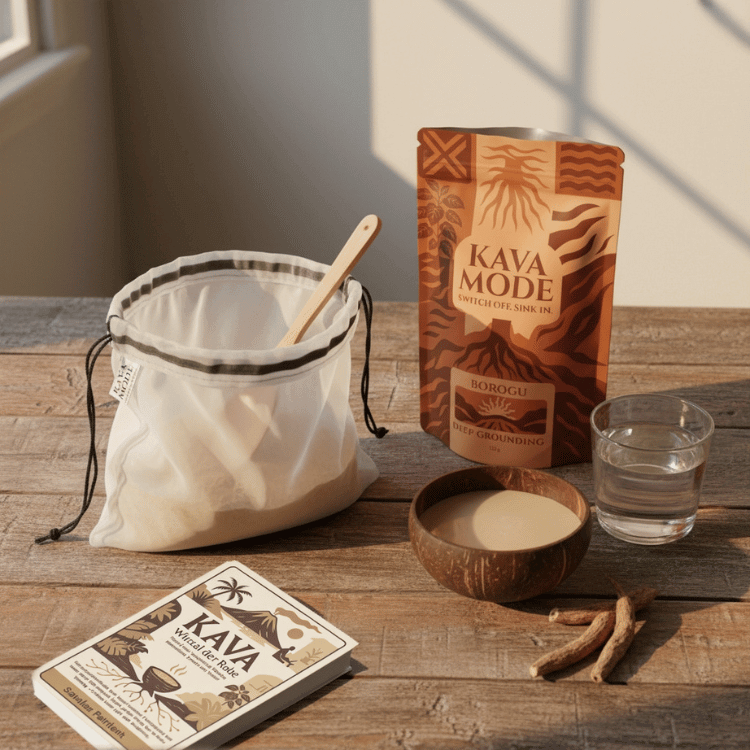
Yes, there are. You can read more about them in our book " Kava - Root of Calm."
Here are some sources:
Heady Kava: Primarily affects the mind - energizing, clarifying and socially activating. Ideal for daytime use and productive activities.
Heavy Kava: Primarily affects the body – relaxing, sedating and muscle-relaxing. Ideal for the evening and relaxation.
Balanced Kava: A balanced effect on mind and body – versatile and ideal for beginners.
Balanced-Heavy Kava: Combines mental calm and social openness with pronounced physical relaxation. Borogu is a typical example.
Our recommendation: Start with a Balanced variety such as Melo Melo to get to know Kava.
For beginners, we recommend:
Not suitable for beginners: Palarasul is intended more for experienced users.
Bir Kar (Heady) is ideal for:
Timing: Bir Kar is particularly suited to daytime use and social or creative situations and should be used before 18 h.
For evening relaxation:
Timing: Use heavy strains only in the evening, about 2 hours before bedtime.
Palarasul is a full-bodied Noble Kava cultivar from Espiritu Santo, Vanuatu. Chemotype variants 423156 or 423165 are reported for the variety. A clear onset, deep physical calm and the feeling often described as “Body Melt” are typical.
For experienced users: Palarasul is particularly suitable for people who already know kava and can easily assess their personal reaction and an appropriate amount.
Noble and Tudei are variety and quality categories.
Noble Kava: High-quality, traditional varieties with usually a short duration of effect of around two to four hours and an effect profile that is described as pleasant. Noble Kava is traditionally drunk regularly in Vanuatu.
Tudei Kava (2-Day Kava): Inferior varieties with a very long duration of action of up to two days, more common unpleasant after-effects and potential health risks.
Kava Mode only uses Noble Kava from Vanuatu.
Traditional water preparation:
Important: Always use cold or lukewarm water – hot water can destroy the kavalactones.
Blender/Mixer method:
This method is faster, but the traditional preparation is often considered more authentic and effective.
The 80-micron mesh size offers the optimal balance:
80 microns is scientifically proven and traditionally proven for optimal kava extraction.
Yes, you can use the same kava powder 2-3 times:
Store the used powder in the refrigerator between extractions and use it within 24 hours or make several extractions one after the other.
Taste improvement:
Avoid: Citrus fruits or acidic additives, as these can interfere with the kavalactones.
Timing by variety:
Meals: Take Kava on an empty stomach for the best effect. Wait 3-4 hours after your last main meal.
Wait 30 minutes before considering a redose. Bir Kar has
sometimes a delayed effect, especially on first use.
Onset of action:
Typical effects:
Dosage guidelines based on experience:
Beginners : 10-25g
Experienced : 15-35g
Expert : 25-50g
Important: Always start with the lowest dose and increase slowly. Wait at least 30 minutes before re-dosing.
Yes, you can drink kava daily. Many people in the Pacific Rim and the international kava community use kava regularly. What is crucial is the right amount, high-quality Noble Kava and mindful use. Regular breaks are useful in order to keep your own perception fresh and to observe what is good for you personally. If you have a medical condition or take medication, kava use should be assessed individually.
Many consumers refer to the experience of perceiving kava more clearly after several uses or of achieving a similarly intense experience with a smaller amount as “reverse tolerance”. This is the opposite of the well-known development of tolerance to alcohol or nicotine, where more and more is often needed for the same effect.
The exact mechanism has not yet been conclusively clarified. Increasing sensitivity to the subtle kava effects, adaptations of receptor and enzyme systems as well as the storage of lipophilic kavalactones in the tissue are discussed as possible explanations.
Practically, this means: Try kava several times, preparing it carefully each time, and do not increase the amount too quickly.
No, according to current evidence, a typical physical dependence syndrome has not been established with kava. Many people use kava regularly and can take breaks at any time. However, as with any ritual, psychological habituation can develop. Very frequent or high consumption can also cause unwanted effects such as dry, flaky skin, but this is 100% reversible once consumption is reduced to normal levels. A conscious approach and regular breaks therefore remain sensible.
Kava dermopathy is a harmless, reversible skin change caused by very frequent, high-dose kava consumption. The skin becomes dry and flaky, especially on the hands and feet.
Prevention:
Reversible: Kava dermopathy disappears completely after reducing or stopping kava consumption and occurs only in about 2% of long-term users.
Noble Kava is safe when used properly. The 2007 WHO assessment confirmed the safety of traditionally prepared Noble Kava.
The liver toxicity controversy arose from:
KAVA MODE Safety: We only use certified Noble Kava roots from Vanuatu.
NEVER combine kava with alcohol! This combination is extremely dangerous and can lead to:
Safety distance: Keep at least 24 hours between alcohol and kava.
Critical interactions with:
Important: Always consult a doctor if you plan to take medication before using kava.
Coffee + Kava: Not recommended, as both have different stimulation mechanisms and can interfere with each other.
Guayusa + Kava: Also not recommended. If you're looking for a natural, gentle energy combination, use these separately:
Better separated: Leave at least 3-4 hours between caffeine and kava for optimal effect.
Kava is not suitable for:
No, this is not recommended!
Kava may impair reaction time , albeit minimally.
Safety distance: Wait at least 3 hours after consuming kava before driving.
Warning signs:
If these symptoms occur: Stop taking the medicine immediately and drink plenty of water.