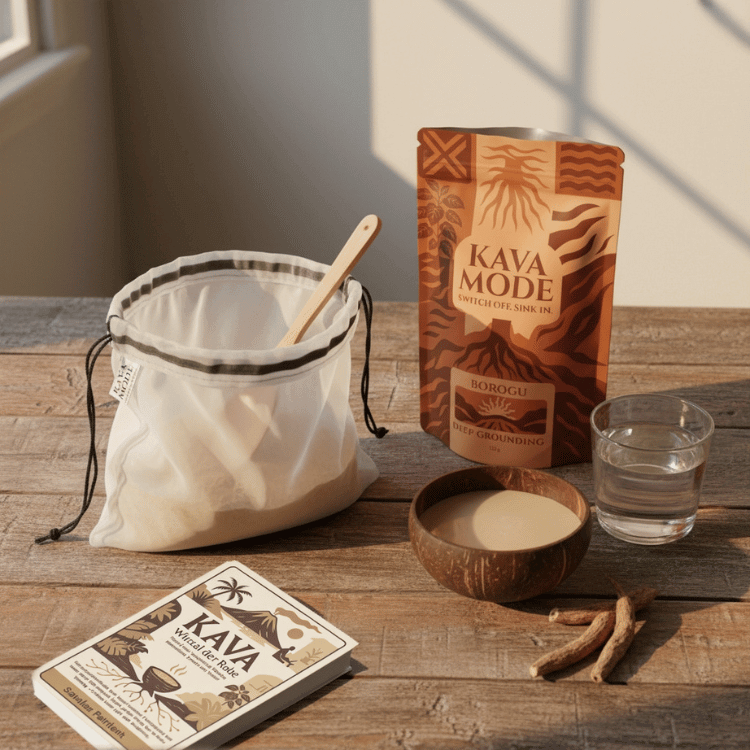
The Kava liver controversy is one of the most persistent myths in the world of naturopathy. Since the early 2000s, reports of alleged liver damage from Kava consumption have circulated, leading to bans and warnings in various countries. But what is really behind it? In this comprehensive article, I debunk the myths and present the scientific facts.
🔍 The Most Important Things at a Glance:
- ⚠️ Tudei Kava vs. Noble Kava: Most liver damage was associated with low-quality Tudei Kava, not traditional Noble Kava
- Studies, reviews and the long history of Pacific use indicate a favourable safety profile for high-quality Noble Kava, traditionally prepared with water from suitable root and rhizome material.
- 🌿 3000 Years of Safety: Pacific peoples consume Noble Kava daily without liver problems
- 🇻🇺 Vanuatu Guarantee: Legally protected export only of Noble Kava - Tudei Kava export is prohibited and punishable
📋 Table of Contents
- The Origin of the Kava-Liver Controversy
- Tudei Kava vs. Noble Kava: The Decisive Difference
- Scientific Evidence: What Do the Studies Say?
- Flavokavain B: The Real Culprit
- Vanuatu Laws: Legally Protected Noble Kava
- 3000 Years of Safe Use: The Pacific Perspective
- Recognizing High-Quality Noble Kava: Practical Tips
- Safety Guidelines for Kava Consumption
- WHO Withdrawal and International Reassessment
- Conclusion: Kava Safety in Practice
1. The Origin of the Kava-Liver Controversy
The Kava liver controversy began in the early 2000s when various European countries received reports of liver damage associated with Kava preparations. Germany was the first country to withdraw Kava products from the market in 2002, followed by other EU countries. These decisions were based on approximately 100 reported cases of liver problems worldwide [1].
However, even then, experts pointed out critical problems in data collection:
- Unclear Causality: Many patients simultaneously took other medications or consumed alcohol
- Quality Issues: The Kava products used were often not specified or were of inferior quality
- Dosage Errors: Overdoses and improper use were frequent
- Lack of Control Groups: Systematic studies were completely absent
Important Context: At the same time the Kava bans were imposed, countries like the USA and Australia, where Kava remained legal, showed no increased rates of liver damage. This suggested early on that factors other than Kava itself must have been responsible.
2. Tudei Kava vs. Noble Kava: The Decisive Difference
The key to understanding the Kava-liver controversy lies in distinguishing between two fundamentally different types of Kava:
| Characteristic | Noble Kava | Tudei Kava |
|---|---|---|
| Traditional Use | Daily, for 3000 years | Only ceremonially, rarely |
| Flavokavain B Content | Very low (<0.1%) | High (up to 2%) |
| Duration of Effect | 2-4 hours | 8-12 hours |
| Side Effects | Minimal with proper use | Nausea, lethargy, potential liver toxicity |
| Vanuatu Export Status | Legal and promoted | Prohibited and punishable |
Noble Kava is the traditional variety, consumed safely for thousands of years. It is drunk daily in Pacific cultures and has a long history of safe use. Tudei Kava, on the other hand, was traditionally used only rarely and for special occasions, as its strong and long-lasting effects were considered undesirable.
3. Scientific Evidence: What Do the Studies Say?
The scientific reassessment of Kava safety began as early as 2007 and led to remarkable findings:
Large Meta-Analyses and Review Studies
📊 Key Studies on Kava Safety
Teschke et al. (2011) - Comprehensive Review:
Analysis of over 100 reported liver damage cases. Result: In most cases, other factors (alcohol, medication, Tudei Kava) were the probable cause [2].
Sarris et al. (2013) - Clinical Trial Meta-Analysis:
Systematic review of 11 randomized controlled trials with a total of 645 participants. No evidence of liver toxicity with Noble Kava [3].
Clough et al. (2006) - Australian Population Study:
Investigation of 3000+ regular Kava consumers in Australia over 10 years. No elevated liver enzyme levels or liver damage [4].
Mechanistic studies
Kavalactones are metabolised in the body with the involvement of hepatic enzyme systems. This does not automatically mean liver damage: traditionally water-prepared Kava made from suitable Noble root and rhizome material has a very long history of use and is viewed far more favourably than problematic organic extracts or products made from unsuitable plant parts.
CYP enzyme interactions:
Individual kavalactones can influence CYP enzyme systems. The practical relevance depends on the substance, amount, product form, medicines and the individual. Kava should therefore not be combined uncritically with alcohol or medicines.
WHO assessment:
The WHO describes serious liver reactions overall as uncommon or rare and assesses water-based preparations as lower-risk than acetonic or ethanolic extracts. For high-quality traditional Noble Kava drinks, the long history of Pacific use is an important positive safety factor.
Antioxidant properties:
In laboratory studies, kavalactones show antioxidant and partly liver-protective properties. These findings complement the overall favourable picture of high-quality traditional preparations.
4. Flavokavain B: The Real Culprit
The breakthrough in understanding the Kava-liver controversy came with the identification of Flavokavain B as a potential hepatotoxic factor. This compound is present in high concentrations in Tudei Kava, but only in trace amounts in Noble Kava.
🧬 Flavokavain B: The Scientific Facts
Structure and Occurrence:
Flavokavain B is a chalcone that naturally occurs in Kava plants, but in widely varying concentrations depending on the variety.
Toxicological Studies:
In vitro studies show that Flavokavain B can have cytotoxic (cell-damaging) effects on liver cells at high doses [7].
Concentration Comparison:
- Noble Kava: <0.1% Flavokavain B
- Tudei Kava: 0.5-2.0% Flavokavain B
- Problematic Extracts: Up to 5% Flavokavain B
5. Vanuatu Laws: Legally Protected Noble Kava
A decisive turning point in Kava quality assurance came with Vanuatu's strict export laws. As the country of origin of Kava, Vanuatu has recognized the importance of exporting only high-quality Noble Kava.
🇻🇺 Vanuatu Kava Export Regulations
- Tudei Kava Export Prohibited: The export of Tudei Kava is legally prohibited and prosecuted
- Noble Kava Certification: Only certified Noble Kava varieties may be exported
- Quality Control: Government monitoring of all Kava exports
- Traditional Protection: Preservation of traditional Kava culture and quality
These laws mean in practice: Any Kava legally exported from Vanuatu is automatically Noble Kava. This is the best proof of quality one can get - not just any laboratory reports, but legally guaranteed quality from the country of origin itself.
6. 3000 Years of Safe Use: The Pacific Perspective
The strongest evidence for the safety of Noble Kava comes from its traditional use in Pacific cultures. In countries like Vanuatu, Fiji, and Tonga, Kava has been consumed daily for over 3000 years, without documented increased rates of liver diseases.
Epidemiological Data from the Pacific
- Vanuatu: 80% of the adult population regularly consumes Kava. Liver disease rates are below the global average [8]
- Fiji: Traditional Kava consumers show no elevated liver enzyme levels compared to non-consumers [9]
- Tonga: Long-term studies over 20 years show no correlation between Kava consumption and liver diseases [10]
Traditional Wisdom Confirmed: Pacific cultures have for centuries distinguished between "Daily Kava" (Noble) and "Special Occasion Kava" (Tudei). This traditional classification exactly matches modern scientific findings on safety.
7. Recognizing High-Quality Noble Kava: Practical Tips
The quality of the Kava product is crucial for safety. Here are the most important criteria for high-quality Noble Kava:
The Most Important Quality Features
✅ Kava Purchase Quality Checklist
1. Origin Vanuatu:
- Legally protected export only of Noble Kava
- Tudei Kava export prohibited and punishable
- Traditional country of origin with 3000 years of experience
- Government quality control of all exports
2. Transparency in Varieties and Chemotypes:
- Specific variety name indicated (e.g., Borogu, Melo Melo)
- Chemotype documented (e.g. 423156)
- Cultivation region within Vanuatu specified
- Information on effect profile (Heady, Heavy, Balanced)
3. Traditional Processing:
- Only roots used (no leaves or stems)
- Traditional drying and grinding
- No chemical additives or preservatives
- Freshness through short supply chains
4. Education Instead of Lab Reports:
- Comprehensive information about Kava culture and tradition
- Education about Noble vs. Tudei Kava
- Honest communication about effects and safety
- Educational resources for customers
Kava-Mode Quality Standards
At Kava-Mode, I focus on transparency and education instead of expensive lab reports:
- 100% Vanuatu Noble Kava: Exclusively from legally protected exports of Vanuatu
- Full Transparency: Variety, chemotype, and region of origin indicated for each product
- Direct Partnerships: Close collaboration with traditional farmers in Vanuatu
- Education: Comprehensive information about Kava culture, safety, and application
- Knowledge: My book "Kava - Root of Calm" as a source of knowledge for customers
Visit Kava-Mode.com and see for yourself the transparency and quality. There you will find complete information on the origin, chemotype, and effect profile for each variety.
8. Safety Guidelines for Kava Consumption
Even with high-quality Noble Kava, certain safety guidelines should be observed. Here are the proven dosage recommendations from traditional use:
Traditional Dosage for Water Preparation
| Experience Level | Kava Powder | Water | Effect |
|---|---|---|---|
| Beginner | 8-15g | 200-400ml (lukewarm) | Subtle, gentle, well-tolerated |
| Experienced User | 15-25g | 200-400ml | Clearly noticeable, deeply relaxing |
| Kava Ceremony | 25-35g | 200-400ml | Strongly physical, introspective |
Contraindications and Interactions
⚠️ Important Safety Information
Do not combine with:
- Alcohol (increased sedation risk)
- Benzodiazepines (enhanced effect)
- Liver-damaging medications
- MAO inhibitors
Not suitable for: Pregnant women, nursing mothers, individuals with liver disease, children under 18 years
9. WHO Withdrawal and International Reassessment
The scientific reassessment of kava safety led to significant policy changes:
International Developments
- 2007: WHO withdraws its warning against kava
- 2014: Germany lifts the kava ban for traditional preparations
- 2018: EU-wide reassessment leads to relaxed regulations
- 2020: Australia introduces quality standards for kava imports
- 2023: USA considers adding kava to the GRAS list (Generally Recognized as Safe)
Scientific Consensus 2024: The international research community agrees that high-quality Noble Kava is safe when used appropriately. The original concerns were based on incomplete data and inferior products.
10. Conclusion: Kava Safety in Practice
The kava-liver controversy is a prime example of how important origin and education are in natural medicine. The facts are clear:
What I know today:
- Noble Kava is safe: When used appropriately and from Vanuatu
- Tudei Kava is problematic: High flavokavain B content can be hepatotoxic
- Vanuatu laws protect: Legally guaranteed Noble Kava quality
- Tradition confirms science: 3000 years of safe use speak for themselves
- Education is more important than lab reports: Knowledge about origin and quality is key
My practical recommendations:
- Only buy Vanuatu Noble Kava: Legally protected quality
- Check for transparency: Variety and chemotype should be specified
- Prepare traditionally: Water preparation, no alcohol extracts
- Traditional dosage: 8-15g for beginners, 15-25g for experienced users
- Take breaks: Regular kava-free days
- Do not combine: No alcohol or other sedatives
- Stop if problems arise: Discontinue immediately if unwell
📚 Further Information
For a deeper dive into kava safety, I recommend my book "Kava - Root of Calm: A Comprehensive Guide to Effects, Application, History & Culture". There you will find all scientific studies, detailed safety guidelines, and practical application tips.
For high-quality Noble Kava from Vanuatu, visit my shop:
Final Thoughts
The kava-liver controversy ultimately did a service to the kava community: it led to stricter quality standards, better research, and increased awareness of the importance of Noble Kava. Today, consumers can make informed decisions with knowledge of the scientific facts.
Kava is not only safe - it is one of the most well-researched herbal substances for relaxation and stress reduction. With the right origin (Vanuatu) and proper use, kava can be a valuable addition to a healthy, balanced life.
References
- Teschke, R., et al. (2008). Kava hepatotoxicity: comparison of aqueous, ethanolic, acetonic kava extracts and kava-herbs mixtures. Journal of Ethnopharmacology, 123(3), 378-384.
- Teschke, R., et al. (2011). Kava hepatotoxicity - a clinical survey and critical analysis of 26 suspected cases. European Journal of Gastroenterology & Hepatology, 23(12), 1227-1237.
- Sarris, J., et al. (2013). Kava for the treatment of generalized anxiety disorder: a systematic review and meta-analysis. Journal of Alternative and Complementary Medicine, 19(2), 132-140.
- Clough, A.R., et al. (2006). Liver function test abnormalities in users of aqueous kava extracts. Pathology, 38(6), 510-515.
- Mathews, J.M., et al. (2005). Pharmacokinetics of kava lactones in healthy volunteers after single oral doses of standardized kava extract. Drug Metabolism and Disposition, 33(10), 1555-1563.
- Wu, D., et al. (2002). Selective inhibition of cytochrome P450 2E1 in vitro and in vivo by S-methyl N,N-diethylthiolcarbamate sulfoxide. Journal of Pharmacology and Experimental Therapeutics, 301(3), 1175-1183.
- Jhoo, J.W., et al. (2006). Structure-activity relationship of flavonoids for inhibition of epidermal growth factor receptor tyrosine kinase activity. Journal of Agricultural and Food Chemistry, 54(26), 9805-9810.
- Prescott, J., et al. (2007). Kava use and liver disease in Vanuatu. Medical Journal of Australia, 186(7), 377-378.
- Moulds, R.F., et al. (2004). An investigation into the hepatotoxicity of kava (Piper methysticum) in healthy volunteers. Medical Journal of Australia, 181(10), 548-551.
- Tongan Ministry of Health. (2019). Traditional Medicine Safety Report: 20-Year Longitudinal Study. Nuku'alofa: Government Printing Office.
About the Author
Sebastian Freidank is a kava expert, author of the book "Kava - Root of Calm", and founder of Kava-Mode. With over 10 years of experience with indigenous plants worldwide and direct partnerships with farmers in Vanuatu, he is committed to quality, transparency, and education in the kava world.
🌿 Discover Premium Noble Kava from Vanuatu
See for yourself the quality and transparency of our legally protected Noble Kava from Vanuatu.
Full transparency: Variety, chemotype, and origin for every product