Alcohol or Kava? This question is being asked by more and more people looking for conscious alternatives for relaxation and social connection. In this comprehensive comparison, I shed light on the scientific differences, societal impacts, and practical pros and cons of both substances – without ideology, only with facts.
🔍 The most important facts at a glance:
- 🧠 Different mechanisms of action: Alcohol acts non-specifically on all neurotransmitters, Kava specifically on GABA receptors
- 🌅 No hangover with Kava: You wake up refreshed, not dehydrated and hungover
- 🎯 Clarity is maintained: Kava relaxes without loss of control or cognitive impairment
- 🔒 No addiction: Kava is not addictive, has no withdrawal, and no tolerance development
- 🌿 3000 years of safety: Traditional use without the societal costs of alcohol
📋 Table of Contents
- Why this comparison is important
- Scientific mechanisms of action in comparison
- Societal and cultural differences
- Practical implications in everyday life
- Safety and side effects
- When to use alcohol, when to use Kava?
- Quality criteria for high-quality Kava
- Safe dosage and preparation
- Conclusion: The future of conscious relaxation
1. Why this comparison is important
We live in a time of change. The "Sober Curious" movement is growing, and more and more people are questioning their alcohol consumption and looking for conscious alternatives. At the same time, people in the West are discovering a 3000-year-old tradition from the Pacific: Kava.
This comparison is not intended to demonize alcohol or glorify Kava. Both substances have their justification and their cultural context. But as someone who has been involved in natural medicine and indigenous plants for over 10 years and has been working intensively with Kava for 1.5 years, I see the need for honest, scientifically sound information.
Important Context: This comparison is based on scientific studies, traditional knowledge, and practical experience. It is not a substitute for medical advice and aims to encourage informed, conscious decisions.
2. Scientific mechanisms of action in comparison
To understand the differences between alcohol and Kava, we need to look at what happens in our brains.
How alcohol works
Alcohol (ethanol) is a central nervous system depressant that acts on multiple neurotransmitter systems:
- GABA system: Non-specifically enhances inhibitory signals
- Glutamate system: Inhibits excitatory signals
- Dopamine system: Stimulates reward center (addiction potential)
- Serotonin system: Influences mood and impulse control
- Acetylcholine system: Impairs memory and cognition
This broad, non-specific effect explains both the diverse effects of alcohol and its numerous side effects.
How Kava works
Kava acts through several well-studied mechanisms and differs markedly from alcohol's broad activity profile.
GABA-A receptors:
Experiments have shown that kavain positively modulates various human GABA-A receptors. This is consistent with the calm clarity that is often described.
Voltage-gated ion channels:
Several kavalactones have been studied in connection with ion-channel mechanisms. These contribute to the physically relaxing and muscle-loosening profile.
CB1 receptor:
Yangonin shows affinity for the CB1 receptor in vitro and is associated with mood-related, sociable profiles.
The experienced difference:
Alcohol broadly affects numerous neurotransmitter systems and can cause disinhibition, loss of coordination and a hangover. Kava, by contrast, is often experienced as relaxing while presence, conversational ability and conscious body awareness are maintained.
Excessive amounts of Kava can cause nausea, fatigue and coordination problems. This is a clear stop signal from the body – not a licence for unlimited consumption.
Comparison table: Mechanisms of action
| Aspect | Alcohol | Kava |
|---|---|---|
| Breadth of effect | Non-specific, all systems | Targeted, specific receptors |
| GABA effect | Direct potentiation | Specific modulation |
| Cognitive impairment | Strong (dose-dependent) | Minimal |
| Addiction potential | High | None |
| Safety mechanism | None | Ceiling effect |
3. Societal and cultural differences
The societal impacts of alcohol and Kava could not be more different.
Alcohol in Western society
Alcohol is deeply rooted in our culture, but the costs are enormous:
📊 Alcohol statistics Germany
- 74,000 deaths annually due to alcohol
- 1.6 million alcohol-dependent people
- 40 billion Euros in societal costs annually
- 200,000 children live in alcohol-affected families
- 13,000 road fatalities due to drunk driving (annually)
In addition, there are social costs: violence, broken relationships, workplace problems, long-term health damage.
Kava in Pacific cultures
In Vanuatu, Fiji, and Tonga, Kava has been used for 3000 years - with completely different results:
- Community-building: Kava ceremonies strengthen social bonds
- Conflict resolution: Traditional mediation under Kava influence
- Spiritually connecting: Kava as a bridge to ancestor worship
- No violence: Kava-induced aggression is unknown
- No traffic accidents: Kava does not impair motor skills
- No addiction: Traditional users can stop at any time
Cultural Context: In Pacific cultures, Kava is consumed with respect, rituals, and a sense of community. Alcohol is often drunk alone, quickly, and thoughtlessly. The context significantly shapes the effect.
Modern Kava bars: A new model
In the USA, more and more Kava bars are emerging, demonstrating what social drinking without alcohol could look like:
- Relaxed atmosphere: Deep conversations instead of superficial chatter
- No aggression: Peaceful, harmonious mood
- Safe drive home: Everyone drives home sober
- No emergencies: No alcohol poisoning or brawls
- True connection: People open up authentically
4. Practical implications in everyday life
The practical differences between alcohol and Kava are dramatic and affect every aspect of the experience.
During the effect
| Aspect | Alcohol | Kava |
|---|---|---|
| Clarity | Decreases with dose | Maintained |
| Motor skills | Strongly impaired | Minimally impaired |
| Memory | Blackouts possible | Fully maintained |
| Emotional control | Disinhibition, aggression | Serenity, openness |
| Social effect | Superficial, loud | Deep, authentic |
After the effect
This is where the biggest differences become apparent:
❌ After alcohol:
- Hangover: Headaches, nausea, dehydration
- Poor sleep: REM sleep disturbed
- Regret: Embarrassing memories or blackouts
- Physical strain: Liver, kidneys, heart
- Emotional instability: "Hangxiety"
✅ After Kava:
- Refreshment: Wake up rested
- Better sleep: Deep sleep often improved
- Clarity: Remember everything
- No physical strain
- Emotional balance
5. Safety and side effects
The safety profiles of alcohol and Kava differ fundamentally.
Alcohol risks
Alcohol is one of the most dangerous legal drugs:
- Acute risks: Poisoning, accidents, violence, risky decisions
- Chronic risks: Liver cirrhosis, cancer, cardiovascular diseases, dementia
- Addiction risk: 10-15% of consumers become addicted
- Withdrawal syndrome: Can be life-threatening
- Tolerance development: Increasingly higher doses necessary
Kava safety
High-quality Noble Kava from Vanuatu has an excellent safety profile:
- 3000 years of safe use in Pacific cultures
- No addiction: No addiction potential documented
- No withdrawal: Can be stopped at any time
- No tolerance: Effect remains constant
- Ceiling effect: Natural protection against overdose
⚠️ Important safety instructions for Kava
Do not combine with:
- Alcohol (can dangerously enhance effects)
- Benzodiazepines or other sedatives
- Liver-damaging medications
Not suitable for: Pregnant women, nursing mothers, individuals with liver disease
6. When to use alcohol, when to use Kava?
Both substances have their justification, but for different purposes:
Alcohol can be useful for:
- Special celebrations (in moderation)
- Cultural or religious occasions
- When the risks are consciously accepted
But: For regular relaxation, alcohol is problematic.
Kava is perfect for:
- Relaxation after work without side effects
- Deep conversations with friends or partner
- Meditation and reflection in a relaxed state
- Social interaction without loss of control
- Stress reduction without physical strain
- Sleep preparation for better recovery
The Sober Curious Movement: More and more people are discovering that consciously abstaining from alcohol doesn't mean deprivation, but enrichment. Kava offers a true alternative - not abstinence, but a better option.
7. Quality Criteria for High-Quality Kava
If you want to try Kava, quality is crucial. Only high-quality Noble Kava offers the described benefits.
The most important quality features:
✅ Quality Checklist
1. Origin Vanuatu:
- Legally protected export of Noble Kava only
- Tudei-Kava export prohibited and punishable
- Traditional country of origin with 3000 years of experience
2. Transparency in varieties:
- Specific variety name (e.g. Borogu, Melo Melo)
- Chemotype stated (e.g. 423156)
- Effect profile described (Heady, Heavy, Balanced)
3. Traditional processing:
- Only roots used (no leaves/stems)
- Traditional drying and grinding
- No chemical additives
4. Education and honesty:
- Comprehensive information about Kava culture
- Honest communication about effects and safety
- Educational resources for customers
At Kava-Mode, I focus precisely on this transparency and quality. Honest education is the basis for trust for me - which is why you'll find complete information on origin, chemotype, and effect profile for every variety there.
8. Safe Dosage and Preparation
Proper dosage and preparation are crucial for a positive Kava experience.
Traditional dosage for water preparation
| Experience Level | Kava Powder | Water | Effect |
|---|---|---|---|
| Beginner | 8-15g | 200-400ml (lukewarm) | Subtle, gentle, well-tolerated |
| Experienced Users | 15-25g | 200-400ml | Clearly noticeable, deeply relaxing |
| Kava Ceremony | 25-35g | 200-400ml | Strongly physical, introspective |
Traditional Preparation Method
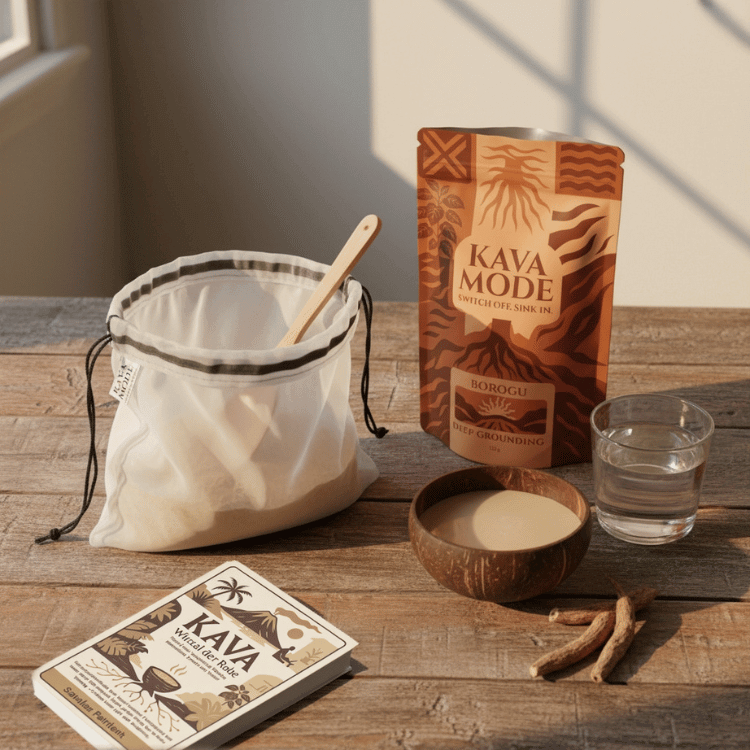
- Place Kava powder in a Kava bag or fine-mesh cloth bag
- Add lukewarm water (not hot!)
- Knead and squeeze intensely for 10-15 minutes
- Strain the liquid - this is your Kava drink
- Drink immediately - do not store
Important: Never combine Kava with alcohol! This can dangerously amplify the sedative effect. Also, do not mix with other sedatives.
9. Conclusion: The Future of Conscious Relaxation
The comparison between Kava and alcohol clearly shows: For true relaxation, stress reduction, and social connection without side effects, Kava is the better choice.
The most important insights:
- Kava relaxes without intoxicating - you remain clear and present
- No side effects like hangover, dehydration, or regret
- No addictive potential - you can stop anytime
- Socially positive - promotes genuine connection instead of superficiality
- 3000 years of safety - proven in traditional cultures
Kava is not suitable for every moment
Kava is not a universal alcohol substitute. It doesn't induce euphoria like alcohol in small amounts and isn't a party booster. But for relaxation, reflection, and deep social connection, it's unbeatable.
The Sober Curious Revolution
We are experiencing a change. More and more people want to deal with substances more consciously. They are not looking for abstinence, but for better alternatives. Kava offers exactly that - a way to relax and connect without paying the price that alcohol demands.
📚 Further Information
For an even deeper dive into Kava, I recommend my book "Kava - Root of Calm: A Comprehensive Guide to Effects, Usage, History & Culture". There you will find all the scientific details, traditional preparation methods, and practical application tips.
For high-quality Noble Kava from Vanuatu with complete transparency:
Final Thoughts
The future of relaxation doesn't have to be in a bottle. It can be in a 3000-year-old root that teaches us that true relaxation is possible without a price. Kava shows us a different way - a way of clarity, connection, and mindfulness.
Whether you choose Kava or not - it's important that you make conscious decisions. Understand what you consume, why you consume it, and what alternatives exist. Your body and mind will thank you for it.
About the Author
Sebastian Freidank has been involved with natural medicine, biohacking, and indigenous plants for over 10 years. For the past 1.5 years, he has been working intensively with Kava, applying the principles he has practiced at drinkguya.com for almost 9 years: direct cooperation with farmers, transparency, and sustainable practices. As the founder of Kava-Mode, he is committed to quality, education, and honest communication in the Kava world.
🌿 Discover the alternative to alcohol
Experience the difference yourself: relaxation without side effects, clarity without loss of control, connection without regret.
Noble Kava from Vanuatu • Full Transparency • Honest Education