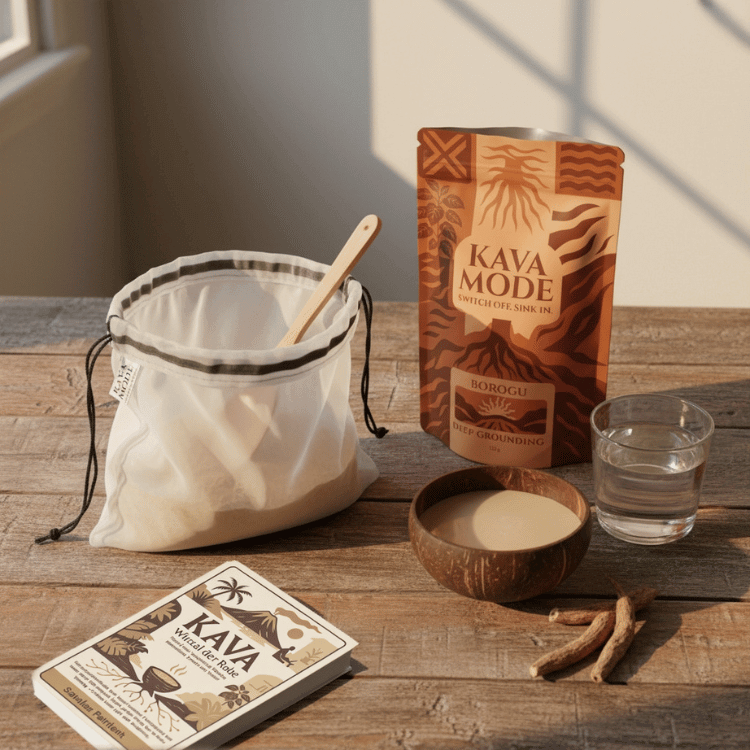
Everything you should know about Piper methysticum, kavalactones, Noble Kava, culture, effects, and safety.
Few plants are as frequently misunderstood as Kava. For some, it's a traditional ritual drink from the Pacific. For others, it's a natural root for relaxation. Still others only know Kava from headlines about liver warnings, bans, or "exotic" Kava bars. The truth is much more exciting: Kava is a plant, a drink, a cultural practice, a research subject, and a question of quality all at once.
This guide answers the fundamental question "What is Kava?" as comprehensively as possible. You will learn where Kava comes from, why Vanuatu plays a special role in the Kava world, what kavalactones are, how to read chemotypes, why Noble Kava and Tudei Kava should not be lumped together, which strain terms beginners should know, and which safety limits are important.
🌿 The Most Important Things at a Glance:
- 🌱 Kava is Piper methysticum: A cultivated plant from the pepper family, traditionally used in the Pacific.
- 🏝️ Kava is also a drink: Traditionally, it is extracted with water from underground plant parts, especially rhizomes and roots.
- 🧬 Kavalactones are the main active compounds: They shape the effects, strain profile, and chemical classification.
- 🔢 The chemotype is the fingerprint: A six-digit number indicates which kavalactones dominate in a strain.
- ✅ Noble Kava is the quality category: Traditionally preferred strains with a more favorable profile, particularly relevant for regular, responsible use by adults.
- ⚠️ Tudei Kava is problematic: Longer, heavier effect profiles and more frequently reported intolerance make this category unsuitable for normal use.
- 🛡️ Safety is paramount: Liver warnings, interactions, alcohol, medications, and contraindications must always be taken seriously.
📋 Table of Contents
- What is Kava in one sentence?
- Kava, Kava-Kava, ʻAwa, Yaqona: Understanding the Names
- The Kava plant: Piper methysticum
- Origin and History in the Pacific
- Kava Culture: Nakamal, Community and Respect
- Kava root and plant parts used
- Ingredients: Kavalactones, Flavokavains, and more
- Chemotypes: The Language of Kava Science
- How are the effects of Kava described?
- Noble Kava vs. Tudei Kava
- Kava Varieties: Melo Melo, Kelai, Palasa & Co.
- Heady, Heavy, Balanced: What do these terms mean?
- Preparation as a Cultural Technique – without Consumption Instructions
- Quality, Transparency, and Origin
- Safety: Liver Controversy, Side Effects, Caution
- Who should not use Kava?
- Interactions with Alcohol and Medications
- Legal Status: Germany, EU, Vanuatu, and International
- The Biggest Kava Myths
- Beginner's Roadmap: Understand First, Then Decide
- Kava A-Z: The Big Glossary
- FAQ: Frequently Asked Questions
- Conclusion: What Kava Really Is
- Sources and Further Reading
1. What is Kava in one sentence?
Kava is both the Pacific cultivated plant Piper methysticum and the traditional drink extracted from its underground plant parts, which, in many island cultures of Oceania, represents community, relaxation, ceremonies, and social understanding.
This brief definition is important because "Kava" can have several meanings in everyday life:
| Meaning | What is meant | Why it is important |
|---|---|---|
| Plant | Piper methysticum from the pepper family | Botany, cultivation, varieties, and origin |
| Drink | Traditional water extract from roots/rhizomes | Cultural practice and traditional use |
| Raw material | Dried and ground Kava root | Quality, processing, and product safety |
| Culture | Rituals, nakamals, exchange, and community | Kava is more than a consumer product |
| Field of research | Kavalactones, chemotypes, safety, and pharmacology | Scientific classification instead of myths |
Kava can only be understood if botany, culture, chemistry, quality, and safety are considered together.
2. Kava, Kava-Kava, ʻAwa, Yaqona: Understanding the Names
In German, the terms Kava and Kava-Kava are often encountered. Internationally, there are many other names that vary depending on the island group, language, and tradition.
🌍 Common Names for Kava
- Kava: internationally used umbrella term
- Kava-Kava: common in German and naturopathy
- ʻAwa: Hawaiian designation
- Yaqona: common in Fiji
- Sakau: known on Pohnpei
- Malok: used in parts of Vanuatu
- Piper methysticum: botanical name
Note: Different names often refer to the same plant or drink – but the cultural context, variety, and preparation method can be very different.
The botanical name Piper methysticum is composed of the genus Piper and the species name methysticum. Piper refers to the pepper family. The second part is often associated with the plant's special psychoactive effect.
3. The Kava plant: Piper methysticum explained botanically
The Kava plant is botanically called Piper methysticum and belongs to the pepper family (Piperaceae). Kew lists it as a perennial plant of humid tropical areas; The database names the Santa Cruz Islands to Vanuatu as its natural distribution area. So Kava is the plant - "Kava root", on the other hand, refers to the plant material used, and "Kava" can also mean the drink prepared from it. Botanical classification: Plants of the World Online, Kew.
The following overview explains the plant. It is not an offer for live Kava plants, cuttings or seeds. If you are looking for root powder, you can find the definition in the Kava-Root and plant parts section.
| Botanical feature | Classification |
|---|---|
| Botanical name | Piper methysticum |
| Plant family | Piperaceae, pepper family |
| Growth habit | Perennial shrub with knotty stems and heart-shaped leaves |
| Relevant plant parts | Mainly rhizome and roots, not leaves or stems |
| Propagation | Traditionally vegetative via cuttings, as cultivated Kava varieties are largely sterile |
| Important growing regions | Vanuatu, Fiji, Tonga, Samoa, Hawaii, Micronesia, and other Pacific island regions |
Not every Kava plant is automatically the same. There are many cultivars, i.e., varieties, that differ in chemotype, kavalactone profile, sensory quality, and traditional use.
4. Origin and History in the Pacific
Kava is deeply rooted in the cultures of Oceania. Vanuatu, in particular, is considered one of the most important centers of Kava culture. From there, Kava spread across many island regions of Melanesia, Polynesia, and Micronesia. In many communities, Kava was and still is associated with social order, councils of elders, ceremonies, conflict resolution, welcoming traditions, and spiritual significance.
Why Vanuatu is so important
Vanuatu plays a special role in the modern Kava world for three reasons:
- Cultural Depth: Kava is not a trend there, but a living everyday tradition.
- Variety: Many of the known Noble Kava varieties originate from Vanuatu or are legally classified there.
- Regulation: The Kava Act of Vanuatu defines Kava, regulates sales and exports, and particularly protects Noble Kava categories.
Cultural Core: In traditional contexts, Kava is not "quick consumption," but a social framework: people sit together, talk, listen, respect order, and experience deceleration as a communal ritual.
5. Kava Culture: Nakamal, Community and Respect
Anyone who views Kava solely as a plant substance misses the most important aspect: Kava is a cultural system. In Vanuatu, the Nakamal is a central place of Kava culture. People gather there, drink Kava in a social setting, discuss matters, resolve tensions, or wind down the day.
Kava as a social language
In many Pacific traditions, Kava creates an atmosphere where conversations become calmer, slower, and more respectful. This sharply distinguishes Kava culture from many Western consumption patterns, which often focus on speed, stimulation, loudness, or escalation.
🏝️ Typical Cultural Functions of Kava
- Welcome: Guests are received into the community.
- Conversation: Kava creates space for calm exchange.
- Ritual: Ceremonies are given structure and meaning.
- Conflict Resolution: Sitting together facilitates understanding.
- Transition: The day is consciously brought to a close.
- Respect: Elders, community, and tradition are honored.
This cultural background is central. Kava is not simply a "hack" for relaxation, but a plant with people, stories, and communities behind it.
6. Kava-Root: roots, rhizome and plant parts used
The term Kava root often refers to the root material of the Piper methysticum plant. It is worth distinguishing between roots and the thickened underground stem, also called the rhizome. Dried material can be offered as pieces or ground powder; A concentrated extract does not automatically equate to this.
The regional Codex standard CXS 336R-2020 distinguishes between suitable plant parts and excludes, among other things, leaves and upper stems. In addition to roots and peeled rhizomes, it also records defined basal stem sections. The general statement “every stem is excluded” would therefore be too inaccurate. The description should clearly state which parts a particular product contains.
Are you already looking for a product? In the Kava purchase advisor you will find the checklist for comparing offers; This is primarily about the raw material.
| Plant part | Traditional Relevance | Classification |
|---|---|---|
| Rhizome / Rootstock | High | Central component of traditional Kava products |
| Lateral roots | High | Often particularly rich in active ingredients, depending on variety and processing |
| Upper stems | Low | Not part of high-quality traditional kava standards |
| Leaves | Low | Are to be critically assessed |
Quality Principle: Kava from root material differs significantly from products made from unsuitable aerial plant parts. This distinction is not a detail, but a core point of the safety debate.
7. Ingredients: Kavalactones, Flavokavains, and more
The most well-known ingredients of kava are kavalactones. They are responsible for many of the described effects and form the basis of the chemotype system. In addition, kava contains other groups of substances such as flavokavains, starch, fibers, minerals, and secondary plant compounds.
The Six Major Kavalactones
In kava science, six kavalactones are particularly frequently considered. They form the core of many strain analyses:
| Chemotype Number | Kavalactone | Frequently Described Role |
|---|---|---|
| 1 | Desmethoxyyangonin | Discussed in relation to focus, mood, and MAO-B |
| 2 | Dihydrokavain | Physical relaxation, traditionally relevant for heavy profiles |
| 3 | Yangonin | Discussion about CB1 activity and mood-related effects |
| 4 | Kavain | Clarity, mental relaxation, heady profiles |
| 5 | Dihydromethysticin (DHM) | Longer-lasting, heavier, more body-focused profiles. DHM has been studied preclinically and is often associated in practical reports with deep physical rest, sedation and longer-lasting effects. If DHM appears very early in the chemotype, this may indicate a Tudei-like profile. |
| 6 | Methysticin | Calming and neurobiologically researched properties |
Flavokavain B: Why this substance is discussed
Flavokavain B is another ingredient that plays an important role in the kava safety debate. Especially with Tudei or lower-quality kava products, a higher flavokavain B content is discussed as problematic. In practice, this means that not only the amount of kavalactones matters, but the entire chemical profile of a variety.
🧬 The Entourage Concept in Kava
Kava is not characterized by a single active ingredient. The effect of a variety arises from the interaction of several kavalactones, other plant compounds, processing, the quality of the root material, and individual factors.
Quality is never one-dimensional: "a lot of active ingredient" does not automatically mean "good quality."
8. Chemotypes: The Language of Kava Science
The chemotype is a six-digit number that describes the relative order of the six major kavalactones. The first number represents the kavalactone with the highest relative concentration, the second for the second most abundant, and so on.
Example: chemotype 423156
The chemotype 423156 means that the kavalactone numbered 4 is dominant, followed by 2, 3, 1, 5 and 6. In this example, the 4 represents Kavain, the 2 represents Dihydrokavain, and the 3 represents Yangonin.
✅ The golden chemotype rule of thumb 🌟
The order of the kavalactones provides a practical indication of the chemical profile and classification as Noble or Tudei.
Noble Kava: The numbers 5 and 6 are typically not in the first two positions, but rather further back in the code. Many Noble chemotypes begin with 42... or 24.... This means: Kavain and Dihydrokavain lead the profile - a common basis for clear, pleasant and traditionally valued effects.
Tudei Kava: If 5 or 6 occur very early in the chemotype, this is a clear warning signal. For example, typical problematic patterns may begin with 25..., 52..., 54... or 65... and are more often associated with more severe, longer-lasting after-effects.
The chemotype is a strong indicator. The final quality assessment also includes confirmed variety identity, suitable plant parts, origin and processing.
Why chemotypes are important for beginners
For beginners, chemotypes initially seem technical. However, they answer three practical questions:
- Which strain is this? A reputable provider should make the strain and origin transparent.
- What profile can be expected? Chemotypes help categorize heady, heavy, and balanced terms.
- Is Tudei risk identifiable? Certain patterns are warning signs in quality control.
9. How is the effect of Kava described?
Kava is traditionally and in modern literature often described as relaxing, calming, physically loosening, socially opening, or centering. The exact experience depends heavily on the strain, chemotype, person, context, quality, and state of health.
| Effect Dimension | Common Description | Important Classification |
|---|---|---|
| Mental | Calmer, clearer, less "thought noise" | Not to be confused with medical treatment |
| Physical | Loosening, heaviness, relaxation | Can be stronger or weaker depending on the strain |
| Social | More talkative, more relaxed, less tense | Traditionally highly context-dependent |
| Sensory | Tingling or numbness in the mouth | Typical sensory property, but not proof of quality alone |
| Sleep-related | Some heavy profiles are described as calming in the evening | Have sleep problems medically evaluated |
No Medical Claims: While kava is scientifically investigated in connection with stress, anxiety, and sleep, it is not a substitute for medical diagnosis, psychotherapy, or prescribed medications. Never discontinue medications independently.
10. Noble Kava vs. Tudei Kava
The distinction between Noble Kava and Tudei Kava is one of the most important foundations of the kava world. It determines whether one is talking about traditional quality profiles or about problematic, heavier, and less tolerable varieties.
| Criterion | Noble Kava | Tudei Kava |
|---|---|---|
| Traditional Significance | Preferred for regular traditional use | Rather problematic, not intended for normal use |
| Chemotype Pattern | Often starts with 4 or 2 | Often starts with 5 or shows 5 very early |
| Effect Profile | Clearer, more controllable, traditionally described as more pleasant | Heavier, longer, more frequently associated with discomfort |
| Flavokavain B | Tends to be lower | Tends to be higher, safety discussion |
| Export from Vanuatu | Regulated export category | Excluded from normal export logic |
This distinction is more important than any marketing description. Noble and Tudei do not belong in the same category because they differ significantly in effect, duration, tolerability, and traditional classification.
11. Kava Strains: Melo Melo, Kelai, Palasa & Co.
Kava is not all the same. Strains differ in origin, chemotype, traditional classification, sensory quality, and frequently described profile. The following strain terms appear particularly often in Kava Wiki, Kava-Mode materials, and the international kava community.
📌 Note on Chemotypes
Chemotypes can vary depending on the source, laboratory, batch, and regional spelling. Serious communication should therefore never just mention a name, but rather make the strain, origin, chemotype, and quality category transparent.
| Strain | Common Category | Brief Profile |
|---|---|---|
| Melo Melo / Melo Melo | Balanced | Known noble strain, often described as balanced and beginner-friendly. |
| Kelai | Heady | Legendary Vanuatu strain, often associated with clarity, talkativeness, and a shorter profile. |
| Palasa | Heavy | Body-focused profile, traditionally more associated with evening use. |
| Palarasul | Heavy | Related to Palasa, often described as physical and intense. |
| Bir Kar | Heady | Clear, sociable and communicative Heady variety with mental lightness and noticeable calm. |
| Borogu | Balanced-Heavy | Calm, sociable and distinctly physically relaxing Balanced-Heavy variety whose physical side can become pronounced depending on preparation, amount and the individual. |
| Borogoru | Classified as Heady to Heavy depending on the source | Very well-known noble strain, whose profile is described differently depending on the region, batch, and presentation. |
12. Heady, Heavy, Balanced: What do these terms mean?
The terms Heady, Heavy, and Balanced are not official medical categories. They are practical community and trade terms used to broadly describe strain profiles.
🧠 Heady Kava
Typical description: mentally clearer, more social, less physically heavy.
Classification: Heady does not mean "stimulating" in the classical sense. It rather refers to a lighter, more head-focused profile.
💤 Heavy Kava
Typical description: more body-focused, muscularly relaxing, calmer, heavier.
Classification: Heavy profiles are often described for evening use. They are not automatically better, just different.
⚖️ Balanced Kava
Typical description: a mix of mental and physical relaxation.
Classification: Balanced strains are often considered versatile, but here too, the experience depends on quality, person, and context.
These terms are helpful, but not absolute. A chemotype, strain, or label does not replace individual caution.
13. Preparation as a Cultural Technique – without Consumption Instructions
Traditionally, kava is understood as a water extract from the underground parts of the plant. The Kava Act of Vanuatu describes kava, among other things, as a traditional beverage obtained through cold-water extraction of the plant's underground organs.
In many Pacific cultures, however, preparation is more than just a technical extraction. It is part of a ritual: preparation, tranquility, sequence, community, bowl, sitting, listening, and speaking. Those who only look at the technique miss the cultural meaning.
Editorial Safety Note: This basic article deliberately contains no step-by-step instructions, dosages, or consumption protocols. Kava is psychoactive and belongs in responsible adult communication with clear boundaries, health classification, and medical caution.
14. Quality, Transparency, and Origin
With kava, quality is not a luxury, but a safety factor. Good kava communication should not rely on vague promises, but on verifiable information.
The five most important transparency points
| Transparency Point | Why it is important |
|---|---|
| Strain | "Kava" alone says too little. Strain names help with classification and traceability. |
| Origin | Island, region, and country provide clues about tradition, regulation, and strain profile. |
| Chemotype | The chemical fingerprint helps distinguish Noble and Tudei patterns. |
| Plant part | Root material is central. Aerial plant parts are critical. |
| Quality Category | Noble, Tudei, wild or medicinal classifications must not be mixed. |
Readers should be able to critically evaluate marketing claims: origin, cultivar, plant part, chemotype, and product form are more important than grand promises.
15. Safety: Liver controversy, side effects, caution
The topic of safety is inextricably linked to kava. In the early 2000s, reports of possible liver damage led to warnings, restrictions, and bans in various countries. Later, the debate became more nuanced: quality, extraction method, plant parts, concomitant medication, alcohol, Tudei content, and individual risks were discussed more extensively.
⚠️ Safety First
- The US FDA warned in 2002 of possible severe liver damage associated with kava-containing dietary supplements.
- People with liver problems or liver-stressing medication should avoid kava or clarify with a doctor.
- Alcohol and sedating medications are particularly critical combinations.
- "Natural" does not automatically mean harmless.
Possible Side Effects
Depending on the product, person, and context, side effects may occur. In literature and practice, these include:
- Stomach discomfort or nausea
- Headaches
- Fatigue or drowsiness
- Skin changes with prolonged or very intensive use
- Interactions with medications
- Liver-related risks, especially with pre-existing conditions, poly-substance use, or problematic products
The correct conclusion is nuanced: no panic, no trivialization. Opportunities, risks, and limitations belong together.
16. Who should not use kava?
Certain groups of people should avoid kava or only come into contact with it after medical consultation. These include:
❌ Kava is not suitable for:
- Minors
- Pregnant and breastfeeding women
- People with liver disease or abnormal liver values
- People who consume alcohol or have alcohol problems
- Individuals taking benzodiazepines, sleeping pills, opioids, barbiturates, or other sedating medications
- People with complex medication without medical consultation
- Individuals who must operate machinery, drive, or perform safety-critical tasks
Especially in cases of stress, anxiety, sleep problems, or psychological complaints: Kava must not serve as an excuse to avoid professional help.
17. Interactions with Alcohol and Medications
Kava affects the nervous system. Therefore, interactions with other depressant or liver-relevant substances are particularly important. The combination with alcohol is generally critical.
| Combination | Risk | Why critical? |
|---|---|---|
| Alcohol | High | Sedating effects and liver strain can be problematically enhanced. |
| Benzodiazepines | High | Both affect calming systems in the nervous system. |
| Sleeping pills | High | Drowsiness and coordination problems can increase. |
| Opioids | High | Centrally depressing effects can become dangerous. |
| Antidepressants / MAO inhibitors | Clarification needed | Kava ingredients are discussed neurochemically; medical consultation is important. |
18. Legal Status: Germany, EU, Vanuatu, and Internationally
⚖️ Legal Disclaimer: This section is an editorial summary as of May 2026 and not individual legal advice. Kava is treated differently depending on the country, product form, labeling, intended use, and marketing. For businesses, labeling, claims, quality documentation, and distribution channels are crucial.
The legal status of kava often appears contradictory because several levels are mixed: kava as a traditional cultural plant, kava as food, kava as a dietary supplement, kava as a medicinal product, concentrated extracts, national enforcement practices, and the EU's Novel Food question. Separating these levels clarifies the situation significantly.
| Level | Classification | Practical Significance |
|---|---|---|
| Traditional Plant | Piper methysticum, deeply embedded culturally in Oceania | Botany and culture do not automatically explain food or medicinal product status in Europe. |
| Food | Traditionally prepared Noble Kava powder from rhizome/rootstock for beverage preparation | According to the legal interpretation used here, generally marketable if properly prepared under food law. |
| Medicinal Product | Kava products with health claims or medicinal presentation | Health-related statements can lead to classification under medicinal product law. |
| Novel Food | EU question of significant consumption before May 15, 1997 | The historical evidence, according to Kava-Wiki and the public draft opinion, argues against a Novel Food classification for traditional Noble Kava products. |
| Enforcement Practice | Review by authorities in individual countries | Even with strong historical arguments, there can be differing assessments and objections. |
Germany: Separate consideration of food law and medicinal product law
In Germany, the kava debate is historically strongly shaped by kava-kava-containing medicinal products. This medicinal product history must not automatically be transferred to traditionally produced foods. Kava-containing medicinal products were known in Germany long before 1997 and later became the subject of medicinal product law proceedings. In 2019, the BfArM again revoked approvals for kava-kava-containing medicinal products, citing an unfavorably assessed benefit-risk ratio in the medicinal product sector.
At the same time, the Higher Administrative Court of North Rhine-Westphalia ruled in 2015 that the revocation of approvals for kava-kava medicinal products at that time was unlawful because milder measures such as adjustments to the approval could have been considered. The court explicitly named risks but also the possibility of reducing these risks through conditions such as limitation, liver value monitoring, alcohol avoidance, and caution with concomitant medication.
Key point for Germany
Medicinal product law measures against certain kava-kava medicinal products do not automatically imply a general ban on traditionally produced Noble Kava foods. Decisive factors are product form, intended use, labeling, quality, documentation of origin, and the absence of medicinal health claims.
Novel Food: Why the cut-off date of May 15, 1997, is crucial
The European Novel Food Regulation addresses the question of whether a food was used to a significant extent for human consumption in the EU before May 15, 1997. The European Commission describes the Novel Food status catalog as a non-binding guidance instrument; food business operators must, if in doubt, be able to demonstrate a relevant history of consumption before this cut-off date.
For kava, several historical pieces of evidence argue against a blanket assumption of novelty: the positive Commission E monograph from 1990, earlier kava medicinal products before 1997, specific historical product names, European market evidence, food/supplement evidence, and the FAO reference to approximately 100,000 kg of kava supplied to Europe in 1996. The public draft opinion of April 13, 2026, therefore concludes that traditionally produced Noble Kava should not be treated as Novel Food.
| Type of Evidence | Significance for the Novel Food question |
|---|---|
| Commission E 1990 | Documents the officially recorded involvement with Piperis methystici rhizoma / kava-kava rootstock before 1997. |
| Historical Preparations | Kava was actually present on the market in Germany and Europe before the cut-off date. |
| IARC/NCBI and Food/Supplement Evidence | Kava products were also described as Food or Dietary Supplements outside the medicinal product context. |
| FAO Supply Quantities 1996 | Approximately 100,000 kg supplied to Europe in 1996 argues against a later market introduction. |
| Recent Authority Coordination | The HoA/BVL context and EU enforcement reports show movement, but also continued inconsistent enforcement. |
What follows from the draft opinion for traditional Noble Kava products
The public draft opinion very specifically formulates the product line that can be classified most clearly under legal terms. This refers to products consisting of Noble Kava, based on rhizome or rootstock, oriented towards traditional water preparation, not marketed as medicinal products, containing no health claims, and transparently documenting origin and quality.
Requirements for a clear food classification
- Noble Kava: no Tudei, wild, or unsuitable cultivars.
- Suitable plant parts: rhizome/rootstock and root material, no problematic aerial plant parts.
- No health claims: no statements such as treatment, cure, or relief of specific diseases.
- No medicinal presentation: product design and communication must not appear as a medicinal product.
- Food law labeling: clear, comprehensible, and legally compliant declaration.
- Documentation: origin, cultivar, quality, and historical non-novelty must be reliably verifiable.
EU: no uniform total ban, but differing practices
At the EU level, according to the legal interpretation analyzed here, there is no uniform total ban on kava as such. The specific product form remains decisive. Kava-Wiki classifies Germany as generally marketable but also points to inconsistent enforcement practices in the EU. Poland is considered a legal market after the old ban was lifted in 2018; the UK is described as restricted due to limitations on sales for human consumption; France appears to be a grey area with strict enforcement practices.
For traders, this is practically relevant: the free movement of goods does not protect against every national objection. Anyone who sells kava commercially should carefully examine the target markets, labeling, health claim rules, Novel Food documentation, and communication with authorities.
Vanuatu: Kava as a cultural asset and legally protected export raw material
Vanuatu plays a special role in the legal status of kava. The country is considered the origin center of cultivated kava varieties and legally protects kava. The Kava Act No. 7 of 2002 regulates, among other things, local sales requirements, export requirements, cultivar categories, and labeling. For export, Noble Kava is the central category: export kava must, by law, be Noble Kava, planted at least five years before harvest, and cultivated using organic methods. In addition, export containers must include, among other things, the cultivar, island of origin, plant parts, and the words "Original Vanuatu Kava."
Two-Day-Kava, Wichmannii-Kava, and products made from these categories are excluded from regular export, apart from special exceptions. This legal distinction explains why origin, cultivar, and plant part in the kava world are not just quality details but legal and safety-relevant information.
USA, California, New Zealand, and Fiji: international movement
Internationally, the kava market is developing dynamically. Kava-Wiki summarizes an important development for the USA: traditionally water-prepared kava beverages are increasingly classified as conventional food in the US context, while capsules, tinctures, and concentrated extracts may be regulated differently. Los Angeles County published a clarification in 2026 stating that water-brewed kava tea may be permissible as a single-ingredient conventional food. New Zealand is discussing kava reforms with a stronger focus on Noble Kava quality, and Fiji is working on its own Kava Act to regulate and strengthen the industry.
These developments show a common pattern: traditional water preparations from suitable kava roots are increasingly evaluated differently from highly concentrated extracts, mixed products, unsuitable varieties, or products with medicinal promises.
Brief Conclusion on Legal Status
Legal Status in One Sentence
Traditionally prepared Noble Kava from rhizome/rootstock, according to the legal interpretation used here, should not be treated as Novel Food in Germany and can be marketable as food, provided it is correctly presented under food law, contains no health claims, and its origin, quality, and historical use are reliably documented.
The earlier German kava debate remains important because it touches on real safety issues. However, it does not replace the independent food law assessment of traditional Noble Kava products. For consumers, health caution is paramount; for businesses, labeling, documentation, and claim compliance are additional considerations.
19. The Biggest Kava Myths
❌ Myth 1: "Kava is just a tea."
Fact: Kava is traditionally a water extract from underground plant parts. It is not a normal tea plant and should not be trivialized as an ordinary herbal tea.
❌ Myth 2: "All kava is the same."
Fact: Variety, chemotype, origin, age, plant part, and processing significantly alter the profile.
❌ Myth 3: "Natural automatically means safe."
Fact: Even plant substances can have side effects, interactions, and risks. Kava requires clear safety information.
❌ Myth 4: "Tudei is just stronger kava."
Fact: Tudei is a different category of quality and safety. "Stronger" here doesn't automatically mean better, but can imply more problematic.
❌ Myth 5: "Kava replaces therapy or medication."
Fact: Kava is not a substitute for diagnosis, therapy, or medical treatment. Professional help is particularly important for anxiety, sleep problems, depression, or addiction issues.
20. Beginner's Roadmap: Understand First, Then Decide
Starting out doesn't begin with "Take this, do that," but with knowledge, self-assessment, and safety awareness.
✅ Responsible Beginner's Checklist
- Understand the term: Kava is a plant, a drink, a culture, and a system of active compounds all at once.
- Check age and health: Kava communication belongs in an adult, health-conscious context.
- Take risks seriously: Liver, medication, alcohol, and sedating substances are key safety topics.
- Learn Noble vs. Tudei: Without this distinction, the most important quality foundation is missing.
- Be able to read chemotypes: The six-digit number is a key to classifying varieties.
- Respect culture: Kava is not just a commodity, but part of living Pacific traditions.
- No self-medication: For medical concerns, seek professional help first.
21. Kava A-Z: The Big Glossary
This glossary will help you quickly understand the most important kava terms.
| Letter | Term | Explanation |
|---|---|---|
| A | ʻAwa | Hawaiian name for Kava. |
| B | Balanced | Variety profile between mental and physical relaxation. |
| C | Chemotype | Six-digit code for the relative kavalactone order. |
| D | Dihydrokavain | Kavalactone, usually represented by digit 2 in the chemotype. |
| E | Entourage effect | Interaction of several plant compounds instead of single substance effect. |
| F | Flavokavain B | Ingredient particularly discussed in the safety debate for Tudei profiles. |
| G | GABA | Important inhibitory neurotransmitter; Kava is discussed in relation to GABA systems. |
| H | Heady | More head-focused variety profile, often described with clarity and talkativeness. |
| I | Island origin | Important information for traceability and cultural context. |
| J | Millennia of tradition | Kava is often described as a very old Pacific cultural plant. |
| K | Kavalactones | Main active ingredients that characterize variety profile and chemotype. |
| L | Liver controversy | Safety debate about possible liver damage, particularly relevant for quality and mixed factors. |
| M | Methysticin | Kavalactone, usually represented by digit 6 in the chemotype. |
| N | Noble Kava | Traditionally preferred quality category with a more favorable profile. |
| O | Oceania | Cultural region where kava traditionally plays an important role. |
| P | Piper methysticum | Botanical name of the kava plant. |
| Q | Quality control | Testing of variety, origin, plant part, chemotype, and processing. |
| R | Rhizome | Rootstock, a central underground plant part. |
| S | Variety | Cultivar with its own profile, name, and chemotype. |
| T | Tudei Kava | Problematic category, also called "Two-Day Kava." |
| U | Underground plant parts | Rootstock and roots, traditionally central components. |
| V | Vanuatu | Central country of origin and legally regulated kava exporter. |
| W | Root material | Quality-relevant raw material, as opposed to leaves or stems. |
| X | X-Factor Context | Culture, setting, and person strongly influence the experience. |
| Y | Yaqona | Fijian name for Kava. |
| Z | Ceremony | Traditional, communal setting in which kava acquires cultural significance. |
22. FAQ: Frequently Asked Questions
What is Kava, explained simply?
Kava is the plant Piper methysticum and also a traditional drink from the Pacific, obtained from the underground plant parts of the kava plant.
Is Kava the same as Kava-Kava?
Yes, in German-speaking countries, "Kava-Kava" is often used. "Kava" is more common internationally.
Is Kava a medicine?
No, kava is not a general medical treatment. Depending on the country and product form, it may be regulated differently. For health concerns, medical advice should always be sought.
Why is Noble Kava important?
Noble Kava describes traditional quality categories with a more favorable chemotype and tolerance profile. It is the most important distinction from Tudei Kava.
What is Tudei Kava?
Tudei Kava, also called Two-Day Kava, is a problematic category with a longer, heavier profile and more frequently reported intolerance. It is not considered a normal quality choice.
What are kavalactones?
Kavalactones are the main active ingredients of the kava plant. They largely determine the chemotype, variety profile, and scientific classification.
What does chemotype mean?
The chemotype is a six-digit code that describes the relative order of the six most important kavalactones.
Can kava affect the liver?
There are international warnings and reports of possible liver-related risks. Quality, product form, concomitant medication, alcohol, pre-existing conditions, and individual factors are crucial. People with liver problems should avoid kava or consult a doctor.
Can minors use kava?
No. This article is designed for adult education. Kava is psychoactive and does not belong in the consumption context of minors.
Can kava be combined with alcohol?
No. Alcohol is a particularly critical combination because sedating effects and liver burden can be amplified.
Can kava be taken with medications?
This should not be done without medical consultation. Particularly critical are sedating medications, sleeping pills, benzodiazepines, opioids, and liver-relevant drugs.
Why does kava taste earthy?
Kava comes from root material. The earthy, bitter taste is typical and part of the traditional sensory experience.
Why does kava sometimes tingle in the mouth?
Kavalactones can cause a local numbing or tingling sensation. This is often described, but it is not a sole proof of quality.
Is kava the same as alcohol?
No. Kava and alcohol are chemically, culturally, and neurobiologically different. Both can have risks, especially with mixed consumption.
Is kava safe?
This question cannot be answered generally. Kava safety depends on product quality, person, health status, interactions, consumption context, and country. A realistic classification therefore always mentions limits and precautions.
23. Conclusion: What Kava Really Is
Kava is not a simple plant, not an ordinary tea, and not a wellness trend that can be understood without context. Kava is a Pacific cultural asset, a botanical peculiarity, a chemically complex system of active compounds, and a quality issue.
The most important realization for beginners is: To understand kava, one must see three levels simultaneously:
- The cultural level: Kava is community, ritual, respect, and deceleration.
- The scientific level: Kavalactones, chemotypes, and variety profiles explain many differences.
- The safety level: Quality, liver issues, interactions, and contraindications must never be ignored.
🎯 The 7 Key Points of This Guide
- Kava is Piper methysticum and a traditional Pacific drink.
- The relevant plant parts are primarily the rootstock and roots.
- Kavalactones are the most important ingredients for variety profile and chemotype.
- Chemotypes help classify quality and effect tendencies.
- Noble Kava and Tudei Kava must be clearly distinguished.
- Vanuatu plays a key role culturally, botanically, and regulatorily.
- Safety is not a secondary topic, but a fundamental part of kava classification.
Kava Mode combines the fascination for this plant with classification, origin knowledge, respect for Pacific culture, and clear safety limits.
24. Sources and Further Reading
- Kava Wiki: Legal Status & Legality. Summary on Novel Food, Germany, EU, international developments and legal opinions, last updated March 2026.
- Kava public expert opinion draft: Kava (Piper methysticum) in Germany and the EU, as of April 13, 2026. Public legal opinion on the food law classification of traditionally produced Noble Kava.
- Sebastian Freidank: KAVA – Root of Calm. A Comprehensive Guide to Effects, Application, History & Culture. Especially Chapters 1, 3, 4, 6, and 8 on botany, culture, kavalactones, safety, varieties, and legal status.
- European Commission: Novel Food Status Catalogue. Non-binding guidance instrument for Novel Food classification.
- BfArM: Kava-Kava-containing medicinal products. Drug law risk information and marketing authorization revocation 2019.
- OVG Nordrhein-Westfalen: Revocation of marketing authorization for Kava-Kava medicinal products unlawful. Press release of February 25, 2015.
- Republic of Vanuatu: Kava Act No. 7 of 2002. Definitions, local sales rules, export requirements, and labeling.
- World Health Organization: Assessment of the risk of hepatotoxicity with kava products. WHO, 2007.
- Lebot, V., Merlin, M., Lindstrom, L. (1997): Kava: The Pacific Elixir – The Definitive Guide to Its Ethnobotany, History, and Chemistry.
- Teschke, R. et al.: Publications on kava hepatotoxicity and the safety debate.
- Sarris, J. et al.: Clinical and systematic studies on kava research in the context of anxiety and stress.
About the Author
Sebastian Freidank has been involved in naturopathy, plant culture, biohacking, and responsible knowledge transfer for years. With Kava Mode, he combines Pacific tradition, modern knowledge transfer, and transparent quality communication.
This article was created as a comprehensive basic article for beginners and as guidance for responsible adult communication.
🌿 To understand Kava is to respect Kava
Botany, culture, chemistry, quality, and safety belong together. The best introduction is not hype, but knowledge.
Noble Kava • Vanuatu Culture • Chemotypes • Transparency • Safety